Buying a vehicle at a forced sale in Connecticut
▸ For Buyers / Operators — Sale channels, title documents, surviving liens, taxes and the checklist appear below.
▸ For Owners / Debtors — Notice, redemption, proceeds and unsettled questions appear in the channel descriptions below.
How these sales happen in Connecticut
Court and execution sales
-
Writ and levy: On the judgment creditor’s application (fee USD 105), stating that the judgment is unsatisfied and any stay and appeal period has run, the clerk issues a property execution against the debtor’s nonexempt personal property other than bank debts and earnings (Conn. 1 Gen. Stat. § 52-356a(a)(1), 1). For a consumer judgment, the application identifies any installment-order stay and, if entered, includes the creditor’s statement of default. 1 For hospital-service judgments, the court must first order installments, find default and lift the mandatory stay; those requirements are not interchangeable (§ 52-356a(a)(1)). 1 The execution must be returned within four months, though a late return does not invalidate a levy made within that period (§ 52-356a(a)(3)). 1 The officer: 1
-
Notice: Notice of the time and place of sale and the officer’s name and address must be (A) sent first class to the debtor and to each holder of a lien or other secured interest at their last-known addresses and (B) posted in the town clerk’s office of the town where the sale will be held, at least 20 days before the sale; perishable or fast-declining property may be sold on shorter notice by ex parte order; the court may order further notice “by publication or otherwise” (§ 52-356a(b)(2)–(3)). 2 Newspaper advertising is optional — the creditor or officer may advertise in legal or classified sections and recover reasonable cost, and the debtor may advertise at its own expense (§ 52-356a(c)). 2
-
Sale conduct: The sale is by the levying officer, an indifferent person deputed by the officer, or another officer the court directs, “at such time and place and in such manner as is commercially reasonable”; the property must be present and within view of those attending unless the court orders otherwise; no sale to the officer or the officer’s agent or associate (§ 52-356a(b)(1)). 2 The statute prescribes no appraisal and no minimum bid (other than the § 52-353 exemption floor) and does not require a public auction in terms. 2 The statute gives no separate authorization for an online-only sale; CT-E01 needs_verification: whether remote video alone satisfies the present-and-within-view requirement without a court order. 2 A court may expressly order otherwise under subsection (b)(1). 2
-
Payment terms: Section 52-356a prescribes no uniform deposit percentage, balance-due interval, credit-sale entitlement or bidder-default consequence; its operative sale standard is commercial reasonableness. 3 This is a bounded statement of the statute, not a promise of cash terms or buyer credit. 3 Any sale-specific terms or court order must be reviewed before bidding. 3
Administrative and tax sales
-
Abandoned, unregistered and “menace” vehicles (police, DMV, parking authorities): As amended by P.A. 4
-
Campground-abandoned recreational vehicles — distinct administrative channel: RCSA §§ 14-150-10–15 requires a DMV-registered campground, DMV owner/title-lender identification and a SOTS secured-party search; a vehicle with no DMV owner/lender record cannot use this route. 5 Abandonment requires at least thirty days after agreement expiry/nonpayment; certified notice goes to camper, owner and lenders within ten days after DMV supplies information. 5 File the transfer-intent notice no sooner than sixty days after abandonment, with agreement, notice proof and USD 5; DMV checks VIN/theft and compliance. 5 After approval, public sale or another lawful disposition requires two newspaper notices within at least ten days preceding disposition and certified copies to the same interested persons. 5 Buyer receives bill of sale, publication/mailing evidence and prescribed campground affidavit. 5 Proceeds pay expenses, DMV-record liens, SOTS interests, campground debt, then owner (unknown-owner excess escheats). 5 No judicial order is prescribed. 5 The rule supplies documents and payment priority; CT-A03 needs_verification whether an unpaid lender interest is extinguished against the purchaser. 5 This is not the ordinary tow-sale age-branch procedure. 5
-
State tax warrants (DRS, Labor, other state collection agencies): If a state tax (other than ch. 216 taxes) is unpaid 30 days after its due date, the collecting agency may issue a warrant to a serving officer “for distraint upon any property … whether real or personal.” 6 The warrant “shall have the same force and effect as an execution issued pursuant to chapter 906,” and the sale is made “in the same manner and with the same force and effect as a levy of sale pursuant to an execution” (Conn. 6 Gen. Stat. § 12-35(a)(3)(A), 6). So notice, sale conduct and buyer’s title track § 12.1: 20-day mailed and town-clerk notice, commercially reasonable sale, buyer takes the taxpayer’s interest subject to senior liens. 6 Distinctive features: 6
Lienholder sales
-
Operative version: 26-24 § 37, effective October 1, 2026; the January 2026 Supplement’s USD 1,500 value branches and 30/60-day minimum-sale floors are superseded. 7 The following rules come from the 7.
-
Priority against a perfected lender: The ordinary-course possessory service-lien rule gives priority unless the lien statute expressly provides otherwise (§ 42a-9-333(b)); § 14-150c contains no such express subordination. 8 This priority does not itself prove buyer-title extinction. 8 Dutch Point, 36 Conn. 8 App. 123 (1994), treated a properly authorized predecessor tow sale as passing title free of liens, making mailed notice to an ascertainable lender constitutionally necessary. 8
Where sales are announced
- Legal-notice statute: A notice required in a daily newspaper may run in a weekly; a court- or statute-required newspaper notice must use a paper with “a substantial circulation in the town in which at least one of the parties, for whose benefit such notice is given, resides” (§ 1-2, 9).
Official channels listed in section 12.7:
What the buyer gets
-
Buyer’s document: Section 52-356a names no mandatory certificate/bill-of-sale form. 10 An officer’s sale proof must establish that transfer; the application does not enlarge the ownership sold. 10
-
Confirmation: None. There is no confirmation hearing; distribution of proceeds is “subject to the supervision of the court” in this order: costs of sale; other levy costs including the officer’s fee of 15% of the amount realized (raised from 5% by P.A. 11 22-26); the executing creditor; subordinate secured parties or lienors who made written demand to the officer before the sale; other executing creditors in order of presentation; then the debtor (§ 52-356a(d)). 11
-
Vehicles (Department of Motor Vehicles) — Execution sale: Buyer’s document: Officer’s proof of levy and sale; § 52-356a names no uniform buyer form DMV paperwork: H-13B application as an involuntary transferee + last title if available + proof of transfer (12) Authority: § 14-181(a) (13)
-
Vehicles (Department of Motor Vehicles) — Municipal alias-tax-warrant vehicle sale: Buyer’s document: Officer’s sworn transfer affidavit DMV paperwork: H-120 rev. 3-2018, warrant, Q-1 Supplemental Assignment of Ownership, and lien-satisfaction evidence if required, with the registration/title application; H-120 records either no title liens, satisfaction, or certified notice and no successful contest Authority: §§ 12-155/162, 14-181(a); 14
-
Vehicles (Department of Motor Vehicles) — Tow/storage lien sale: Buyer’s document: DMV affidavit of compliance DMV paperwork: Current H-100 intent form; H-114 initial tow notice; H-110 rev. 06-2026 sale notification (original to purchaser); versions and statute/form limits in § 12.3 Authority: § 14-150c(f); 15
-
Vehicles (Department of Motor Vehicles) — Repair (artificer’s) lien sale: Buyer’s document: DMV affidavit of compliance DMV paperwork: H-100A notice with repair invoice and USD 10; DMV-issued H-76 to purchaser; H-13B application Authority: § 49-61(b) 16
-
Vehicles (Department of Motor Vehicles) — Self-storage sale of a vehicle: Buyer’s document: H-125 rev. 3-2018, bill of sale, two newspaper notices, owner/lender notice and mailing proof DMV paperwork: Facility H-123/H-124, DMV approval, H-13B application, VIN verification and applicable registration requirements; CT-T01 resolved Authority: § 42-160(b)–(c); RCSA § 42-160-6(e)–(g); 17
-
Vehicles (Department of Motor Vehicles) — Abandoned vehicle (municipal): Buyer’s document: Town’s vested title; recycler transfer DMV paperwork: H-109, rev. 3-2018, municipal ownership transfer in lieu of title; DMV notified within 48 hours Authority: § 14-150(d); RCSA § 14-150-9 18
-
Vehicles (Department of Motor Vehicles) — Court order (e.g., § 52-500 sale): Buyer’s document: Court order DMV paperwork: § 14-181(a) involuntary-transfer path Authority: § 14-181(a) 19
-
Surviving liens and the title record: A new title issued after an involuntary transfer “is not conclusive upon the rights of an owner or lienholder named in the old certificate” (§ 14-181(c)). 20 Security interests in titled vehicles are perfected by notation on the title (§ 14-185(a)); a buyer who takes a new title clean of a notation is not thereby insulated from a senior lien that the sale did not discharge (execution sales are expressly subject to senior interests, § 52-356a(b)(1)). 20
-
Branding / salvage: Section 14-16c requires a total-loss title marked SALVAGE, or SALVAGE PARTS ONLY where ten or more major component parts are beyond repair; supply the damage report and original branded certificate to the next purchaser. 21 A salvage vehicle cannot ordinarily be operated, registered or retitled until the prescribed inspection; the licensed dealer/repairer inspection-trip exception is limited. 21 Insurer/self-insurer salvage sales are limited to specified licensees; parts-only sales have a narrower recycler restriction. 21 The theft-recovery/no-or-minimal-damage exception in subsection (f) must be evaluated separately. 21 A forced sale does not remove these requirements. 21
-
Fees: Certificate of title application USD 25; each security interest noted USD 10; late-filing penalty equal to the fee if documents are not delivered within 10 days (§ 14-192(a)–(b), 22).
-
Repossession is different: An Article 9 secured party uses a § 15-218 secured-party transfer statement, not § 15-219, with default/remedy/transfer authority, owner and transferee identification and title-status information. 23 Issuing a new title does not itself complete an Article 9 disposition or excuse its duties. 23
-
Security interests: For titled vessels, perfection ordinarily requires DMV title application/notation under § 15-214, not only SOTS UCC filing. 24 Inventory and vessels excluded from titling have the statutory exceptions. 24 Section 15-223(b) independently protects a nondealer buyer giving value, possession, good faith and lack of knowledge after DMV creates an erroneously clean certificate; it is not a general immunity for every marina purchaser. 24
-
DEEP/federal interplay: DEEP’s notice of assumed ownership is the § 15-140c(h)(7) operation-of-law evidence and lien-termination instrument for an eligible undocumented vessel. 25 Section 49-55’s vessel lien excludes federally documented vessels; DEEP’s termination stage likewise excludes them. 25 Apply federal documentation and preferred-mortgage rules through uscg-national-vessel-documentation-center and vessels. 25
Taxes and fees
-
Motor vehicles (general): Rate and base: 6.35% Who collects: Dealer; or buyer pays use tax to DRS before registering if bought from anyone other than a licensed dealer or lessor Forced / casual sale rule: Execution, lien and private sales are non-dealer purchases → use tax on “total purchase price,” which for vehicles is presumed to be a DRS-adopted valuation-book value “regardless of the value placed on the motor vehicle at the time of the purchase” unless the buyer proves otherwise Authority: §§ 12-408(1)(A), 12-431(a)(1), (b) (26)
-
Motor vehicles over USD 50,000: Rate and base: 7.75% on the entire price (excludes vehicles over 12,500 lb GVWR and commercially registered business vehicles) Who collects: Same Forced / casual sale rule: Same Authority: § 12-408(1)(H)(i) 26
-
Family and reorganization exemptions: from the casual-sale use tax (spouse, parent, sibling, child; transfers on organizing or liquidating an incorporated business, partnership or LLC where the last sale was taxed; rebuilt total-loss vehicles) do not fit typical forced sales (§ 12-431(a)(2)). 27
-
Casual does not mean vehicle/vessel/aircraft tax-free: RCSA § 12-426-17(a), (d)(2) expressly excludes those classes from the general casual-sale exemption; apply § 12-431 and the specific family/aircraft/vessel exemptions. 28 A court sale of equipment and an auctioneer sale are therefore different tax channels. 28
-
Transfer fees: Vehicle title USD 25, each security interest USD 10, § 14-192(a). 29 Section 14-49 base registrations: passenger USD 120/three years; motorcycle USD 63/three years; registration transfer USD 21; recreational trailer USD 28.50/three years; camper USD 112.50/three years; weight-based commercial/other-trailer charges use § 14-47. 29 These are base fees, not an all-in invoice: plate, clean-air, Passport-to-Parks, emissions and other applicable charges may add to them. 29 Vessel title USD 25, lien USD 10, with registration based on length/class under § 15-144; no single flat vessel fee. 29
Step-by-step checklist
-
Execution and tax-warrant sales take subject to senior liens: (§ 52-356a(b)(1)); run a Secretary of the State UCC and judgment-lien search (§ 52-355a) and a DMV title check before bidding. 2
-
Vehicle exemption floor: A debtor’s vehicle can be sold only if the bid at least equals the exemption, which is paid to the debtor first (§§ 52-352b(10), 52-353) — except on a municipal tax warrant, which overrides the vehicle exemption (§ 12-162(b)(1)). 30
-
Exempt-property sales: A bona fide purchaser keeps title even if exempt property was wrongly sold (§ 52-361b(g)). 31
-
Tow sales from October 1, 2026: Verify the fifteen-model-year age branch, thirty days before intent notice, DMV approval, the subsequent five-business-day sale notice and the younger-vehicle auction advertisement. 32 Sale notices use regular mail; initial tow notices use both regular and certified mail. 32 Use the directory’s on/after-October H-100/H-114, not the superseded H-100 1-2026; neither form overrides **P.A. 32 Obtain H-76 and original H-110; distinguish priority from unresolved CT-L01 buyer title. 32
-
Repair-lien vehicles: Need a DMV affidavit of compliance and a sale at least three months after the work was finished (§ 49-61(b), (d)). 33
-
Retail-installment repossessions: Consumer resales must occur 15–180 days after retaking on 10 days’ notice (§ 36a-785(d)); the buyer takes under § 42a-9-617. 34
Open questions
Section 12 leaves the following matters unsettled (needs_verification).
-
Sale conduct: The sale is by the levying officer, an indifferent person deputed by the officer, or another officer the court directs, “at such time and place and in such manner as is commercially reasonable”; the property must be present and within view of those attending unless the court orders otherwise; no sale to the officer or the officer’s agent or associate (§ 52-356a(b)(1)). 2 The statute prescribes no appraisal and no minimum bid (other than the § 52-353 exemption floor) and does not require a public auction in terms. 2 The statute gives no separate authorization for an online-only sale; CT-E01 needs_verification: whether remote video alone satisfies the present-and-within-view requirement without a court order. 2 A court may expressly order otherwise under subsection (b)(1). 2
-
Setting a sale aside: Before disposition, a debtor may seek a § 52-400a(b) protective order against an illegal levy; third-party interests can be adjudicated under § 52-356c; exemption claims under § 52-361b(d) are due twenty days after levy. 31 CT-E03/CT-E04 needs_verification: the grounds for rescinding a completed personalty execution sale against its purchaser, and the applicable filing deadline. 31 Neither § 52-356a nor § 52-400a states a special completed-sale rescission period; the four-month judgment-opening rule is not a verified sale-challenge deadline. 31 (31) Statutory remedies run against the creditor and officer rather than the buyer: wrongful sale of exempt property leaves title in a bona fide purchaser (§ 52-361b(g)); an officer who fails to give an itemized fee statement forfeits three times the fees (§ 52-356a(e)). A debtor may move to set aside the judgment within four months of rendition (§ 52-361b(a)(4), referring to § 52-212). 31
-
Court-ordered sale of co-owned personalty: A court with equitable jurisdiction may order sale of property owned by two or more persons when sale better promotes their interests (§ 52-500(a)). 35 CT-E05 needs_verification: which lien interests survive a personalty partition sale; no general clean-title effect is inferred from the power to order sale. 35
-
Buyer title: Town-recycler transfers pass the town’s vested title (§ 14-150(d)); CT-A02 needs_verification: discharge or survival of an unpaid prior lien in this municipal/recycler channel, which is not answered simply by the vesting sentence; § 14-150c sales pass with the DMV affidavit of compliance (§ 14-150c(f)). 36 For a municipal vested-title transfer, H-109 is furnished in lieu of a title under RCSA § 14-150-9. 36
-
Campground-abandoned recreational vehicles — distinct administrative channel: RCSA §§ 14-150-10–15 requires a DMV-registered campground, DMV owner/title-lender identification and a SOTS secured-party search; a vehicle with no DMV owner/lender record cannot use this route. 5 Abandonment requires at least thirty days after agreement expiry/nonpayment; certified notice goes to camper, owner and lenders within ten days after DMV supplies information. 5 File the transfer-intent notice no sooner than sixty days after abandonment, with agreement, notice proof and USD 5; DMV checks VIN/theft and compliance. 5 After approval, public sale or another lawful disposition requires two newspaper notices within at least ten days preceding disposition and certified copies to the same interested persons. 5 Buyer receives bill of sale, publication/mailing evidence and prescribed campground affidavit. 5 Proceeds pay expenses, DMV-record liens, SOTS interests, campground debt, then owner (unknown-owner excess escheats). 5 No judicial order is prescribed. 5 The rule supplies documents and payment priority; CT-A03 needs_verification whether an unpaid lender interest is extinguished against the purchaser. 5 This is not the ordinary tow-sale age-branch procedure. 5
-
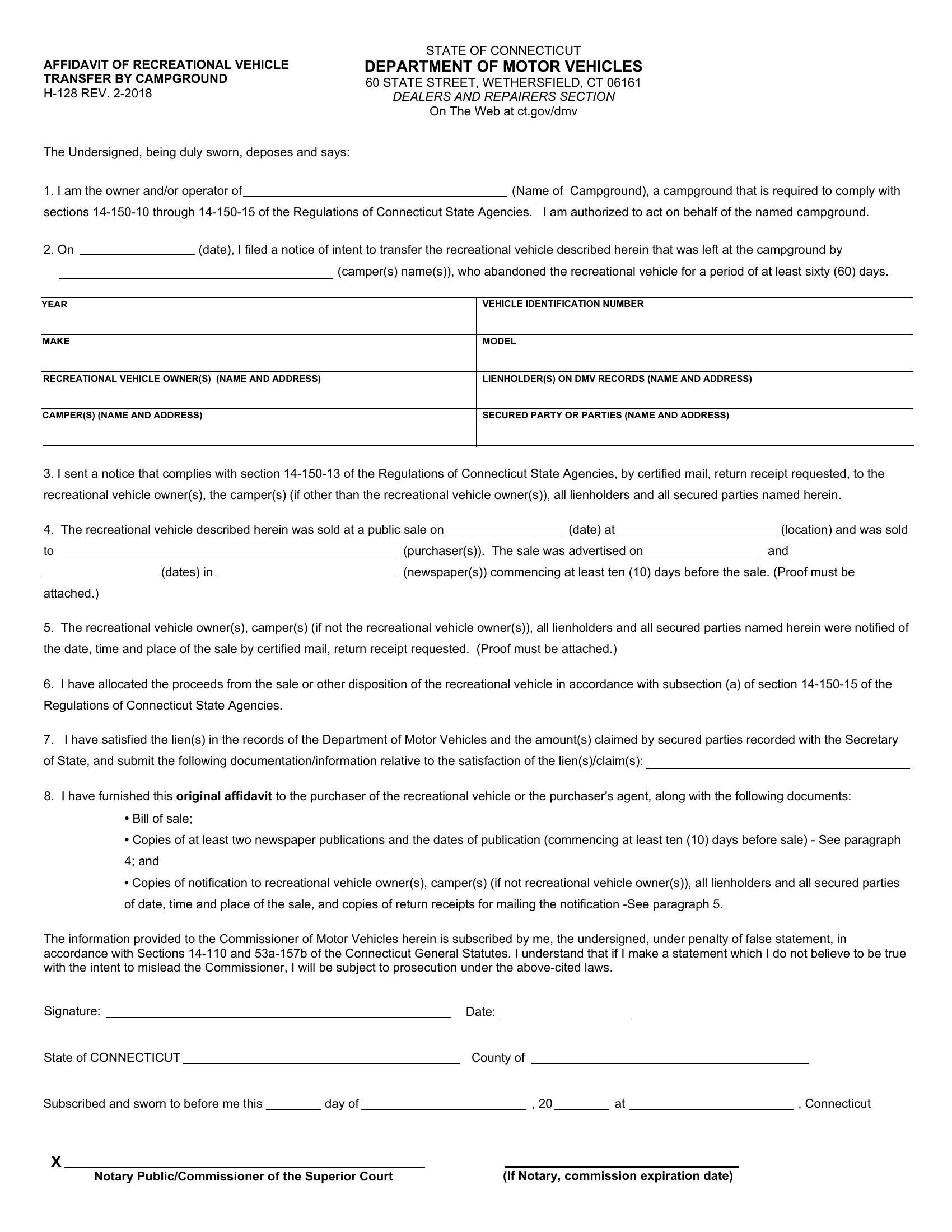
Campground affidavit — identification verified; current approval still CT-T02: The complete DMV-authored **H-128, Affidavit of Recreational Vehicle Transfer by Campground, REV. 37 It identifies the camper, owner, DMV lenders and SOTS secured parties; records the public sale and notices; requires publication/mailing evidence and a bill of sale; and, in paragraph 7, attests that both DMV liens and SOTS claims have been satisfied, with supporting documentation. 37 It is sworn before a notary or Superior Court commissioner. 37 This is stronger than merely certifying allocation of proceeds and is not evidence that an unpaid lien disappears. 37 CT-T02 needs_verification is now limited to present DMV approval/acceptance of that revision or a replacement packet: the current public directory links H-126/H-127 but not H-128. 37
-
State forfeiture sales: Property forfeited in an in rem civil proceeding for drug-sale or money-laundering offenses (petition within 90 days of seizure; clear-and-convincing standard; hearing within two weeks after the criminal case ends; forfeiture only after a plea, a guilty verdict or completion of diversion) “shall be sold at public auction conducted by the Commissioner of Administrative Services”; proceeds pay first “the balance due on any lien preserved by the court,” then storage and forfeiture costs and court costs (Conn. 38 Gen. Stat. § 54-36h(b), (c), (f), (g), 39). 40 Innocent owners and lienholders keep their interest if they did not know and could not reasonably have known of the criminal use (§ 54-36h(d)). 38 25-41 re-letters the section and adds virtual currency, effective July 1, 2026 (sale rule now § 54-36h(g)) (41). 42 Preserved liens are paid first from proceeds, not automatically imposed on the purchaser. 38 The buyer receives the interest actually forfeited; an innocent interest excluded from forfeiture is outside the State’s sale. 38 CT-A01: needs_verification whether an unpaid court-preserved lien remains enforceable against the auction buyer under each of §§ 54-36h, 54-36o and 54-36p; a proceeds priority is not an express discharge rule. 38
-
Priority against a perfected lender: The ordinary-course possessory service-lien rule gives priority unless the lien statute expressly provides otherwise (§ 42a-9-333(b)); § 14-150c contains no such express subordination. 8 This priority does not itself prove buyer-title extinction. 8 Dutch Point, 36 Conn. 8 App. 123 (1994), treated a properly authorized predecessor tow sale as passing title free of liens, making mailed notice to an ascertainable lender constitutionally necessary. 8
-
Court required: No ordinary judicial sale order; DMV approval and affidavit are required. A pending owner hearing application communicated to the keeper blocks the intent notice; an unresolved § 14-63 owner complaint blocks DMV approval (§ 14-150c(b), (d)).
-
Buyer document and remaining title question: Deliver DMV’s affidavit to the purchaser at sale (§ 14-150c(f)), together with the original H-110, rev. 06-2026. 43 H-110 records seller, buyer, sale price, charges and escrow; it is not the affidavit or an express release of a lender’s interest. 43 CT-L01 remains open as stated above. 43
-
Buyer document/title: The vehicle purchaser receives DMV’s H-76 affidavit of compliance; the repairer’s intent form is H-100A, rev. 2-2018, accompanied by the repair invoice. 44 The bailee is paid first and the conditional seller next, but CT-L02 needs_verification: whether a perfected lender’s unpaid balance is extinguished by a fully compliant § 49-61 sale, including a sale of special mobile equipment. 44 Section 14-181(c) makes a new vehicle title nonconclusive of prior owner/lender rights. 44
-
Court required?: No judicial order; DMV approval and affidavit of compliance; a pending owner hearing or unresolved § 14-63 complaint blocks the steps (§ 14-150c(b), (d)).
-
What the buyer takes: needs_verification — The buyer receives the affidavit and H-110 (§ 14-150c(f)), but whether every lien, including a contested or omitted one, is extinguished under the amended statute is unresolved; a new title is not conclusive of prior rights (§ 14-181(c)) (CT-L01). 45
-
DMV / title notice: needs_verification — None prescribed; whether other statutes apply to titled items is not stated.
-
DMV / title notice: needs_verification — None prescribed.
-
Priority vs a perfected security interest: needs_verification — Not stated.
-
DMV / title notice: needs_verification — Not stated.
-
Department of Administrative Services: conducts forfeiture auctions (operative § 54-36h(g)); The current 46 links public property/vehicle auction instructions and police found/seized/unclaimed-goods procedures. CT-P02 needs_verification: which public channel DAS uses specifically for judicially forfeited property under §§ 54-36h/o/p; ordinary surplus/found-property procedures are not proof of that assignment. 47
-
Forfeited-vehicle distinction actually found: DAS’s 48 expressly excludes seized/forfeited vehicles from agency/municipal reallocation and identifies Property Room as its online vehicle-auction channel. DAS police procedure That establishes a forfeiture-specific vehicle-program distinction, rather than merely inferring it from the found-property page. 49 It does not identify a dedicated §§ 54-36h/o/p feed or prove that nonvehicle judicial forfeitures use the same contractor. 49 CT-P02 remains open on that exact assignment, particularly nonvehicle property. 49 The police page and its DPS-38A rev. 01/2025 concern the § 7-285 found/unclaimed route; the word seized in the form’s title is not a substitute for a judicial forfeiture order. 49
-
Tow sales from October 1, 2026: Verify the fifteen-model-year age branch, thirty days before intent notice, DMV approval, the subsequent five-business-day sale notice and the younger-vehicle auction advertisement. 32 Sale notices use regular mail; initial tow notices use both regular and certified mail. 32 Use the directory’s on/after-October H-100/H-114, not the superseded H-100 1-2026; neither form overrides **P.A. 32 Obtain H-76 and original H-110; distinguish priority from unresolved CT-L01 buyer title. 32
Related
Primary sources
Legal information, not legal advice. Verify against the cited primary sources before acting. Last verified: 2026-10-18.
Footnotes
-
§ 52-356a; § 52-356a(b)–(d), full text ↩ ↩2 ↩3 ↩4 ↩5 ↩6 ↩7 ↩8 ↩9 ↩10 ↩11
-
Full operative RCSA §§ 14-150-10–15 ↩ ↩2 ↩3 ↩4 ↩5 ↩6 ↩7 ↩8 ↩9 ↩10 ↩11 ↩12 ↩13 ↩14 ↩15 ↩16 ↩17 ↩18
-
Article 9; Dutch Point, full opinion; § 14-181 ↩ ↩2 ↩3 ↩4 ↩5 ↩6 ↩7 ↩8
-
Full mirrored agency blank; DMV directory; RCSA § 14-150-15(e)–(g) ↩ ↩2 ↩3 ↩4 ↩5
-
chap_959; 2026 Supp. chap_959; Full §§ 54-36o–p; operative § 54-36h ↩ ↩2 ↩3 ↩4 ↩5
-
DAS surplus hub; police found/seized/unclaimed-goods procedures ↩
-
vehicle reallocation overview; DAS police procedure ↩ ↩2 ↩3 ↩4