Buying a business at a forced sale in Iowa
▸ For Buyers / Operators — Sale channels, title documents, surviving liens, taxes and the checklist appear below.
▸ For Owners / Debtors — Notice, redemption, proceeds and unsettled questions appear in the channel descriptions below.
How these sales happen in Iowa
Court and execution sales
-
Writ and levy: A judgment/order is enforced by execution. 1 Rule 1.1020 creates the personalty levy lien only when the officer takes possession and appends an exact signed description, or, on written creditor request, views/inventories the goods and files the certified inventory/statement with the secretary of state. 1 Written notice of levy is served on the debtor under § 626.50; rule 1.1018 limits successive levies to enough to satisfy the writ and costs. 1 The sheriff/officer receiving the writ; the distress-warrant substitutions described in 12.2 apply only when authorized. 1
-
Execution notice: Three weeks before a chattel sale (§ 626.74). 2 Posting plus newspaper publication when personalty is worth at least USD 200; separate written levy notice under § 626.50. 2 At least three county public places including the courthouse. 2 Section 626.75 requires TWO weekly publications in a county newspaper, first at least three weeks before sale and second later before sale; it does not require publication twice every week. 2
-
Payment and default: No uniform chattel bidder deposit is prescribed by § 626.80; the sheriff may require sealed bids to include purchaser fees and returns them to an unsuccessful bidder. 2 Pay on demand and under the noticed payment instructions; a winning sealed bid must be paid in certified funds as directed. 2 The general execution provisions do not grant installment credit; a bidder cannot substitute personal financing for the noticed demand. 2 For an unpaid sealed winning bid, cancellation and certification of the next-highest bidder within 24 hours for electronic transfer or 48 hours otherwise after notice of results. 2 Under § 626.85 the judgment holder may sue for the price, or the sheriff may treat nonpayment on demand as a nullity and resell that day or after a lawful postponement. 2
Administrative and tax sales
-
State collections: Department of Revenue under § 422.26; Workforce Development under § 96.14; Inspections, Appeals, and Licensing under § 10A.108 for improper benefits/provider payments. 3 Each is its own authorization. 3 The underlying assessment/collection notice and the distress warrant precede ch. 626 levy/sale notice. 3 Revenue § 422.26(7) and benefits § 10A.108 permit authorized agents/investigators to serve after five days without sheriff service. 3 Chattel sale notice remains three weeks, postings and the conditional two newspaper publications. 3 Chapter 626 execution procedure, including appraisal/public auction. 3 Revenue and unemployment collection override exemptions; benefits § 10A.108(1) excludes ch. 627-exempt property. 3 Local public-utility replacement tax suits use §§ 437A.11 or 437B.7 and § 445.3. 3 Actual debtor interest under execution and the paid/adjudicated priorities described in 12.1; a distress warrant does not universally cancel other liens. 3 Revenue lien recording protects against later purchasers/lenders without notice under § 422.26, while § 423.42 makes sales/use-tax personalty liens prior to subsequent liens without recording. 3 Additional state-tax incorporation branches and their different priorities are in 12.3. 3
-
Local collection: Ordinary county-treasurer personal collection is a suit at law under § 445.3 with attachment without bond under § 445.4, followed by judicial execution. 4 This is not the state revenue distress warrant. 4 Reserved § 445.45 supplies no current migratory-personalty tax lien. 4 Independently created utility replacement liens and apiarist-cost collection are separately stated in 12.3. 4
-
Forfeiture: Iowa Code ch. 809A, especially §§ 809A.5, .12A, .16–.17; Attorney General rules in 61 IAC ch. 30. 5 The unclaimed-property declaration route in § 809A.16 applies to qualifying seized personalty worth USD 5,000 or less after thirty days without a claim; defective-notice relief has its separate 180-day period. 5 Judicial forfeiture and the below-minimum-conviction/exception rules in § 809A.12A must also be satisfied. 5 The Department of Justice may retain, transfer, sell or lawfully destroy forfeited property; an exempt regulated lienholder receiving property must conduct a commercially reasonable PUBLIC sale and remit excess over its debt within ten days. 5 Innocent owner/interest protections in § 809A.5 and the release/payment provisions of § 809A.16(5)–(6) precede sale. 5 Section 809A.16(7) authorizes the state’s good and sufficient title recognized by Iowa courts/agencies; it is not an excuse to skip protected interests. 5 Sale surplus otherwise follows the forfeiture/distribution statute, not an ordinary debtor overplus claim. 5
-
Animal disposition and owner funds: The lien created for emergency livestock sustenance is separately recorded at L34. 6 Nonlivestock neglected-animal disposition under § 717B.4 requires the court’s hearing/disposition order; local care expenses and liens/security interests are treated in its proceeds priority. 6 It does not grant every rescuer a statutory veterinary lien or an unconditional right to keep all sale proceeds. 6 Court-directed transfer/sale/adoption/destruction must be distinguished: adoption or destruction alone is not an auction buyer channel. 6
Lienholder sales
-
Basis, holder, priority and limit: Livery/feed-stable keeper, herder or feeder lawfully holding stock. 7 Subject to ch. 579A and all prior liens of record; no blanket priority over a previously perfected recorded lender. 7 Actual keeping/feeding charges and keeping expenses; no independent fixed-dollar maximum. 7
-
Court and owner notice: No prior court order for the chapter’s sale. 7 Ten days’ written notice of sale time/place to owner/claimant if found within the county. 7
-
Other claimants and title agency: Chapter 579 adds no separate lender-mail requirement; a prior recorded lien is not canceled by omitting its holder. 7 No agency notice for stock. 7
-
Advertising, wait and sale: Post sale notice at three public places in the township where kept (§ 579.2). 7 Unpaid charges and the ten-day written owner-notice rule where the claimant is found; posting is separately required. 7 Public auction under § 579.2, or independently authorized judicial attachment under ch. 640. 7
-
Buyer title, residue and defects: Interest lawfully subject to the lien; prior liens of record and the ch. 579A priority remain unless independently released/adjudicated. 7 The chapter has no general free-and-clear buyer clause. 7 Charges and sale expenses first; balance to owner or claimant (§ 579.3). 7 No ch. 579 statutory good-faith cure of a defective sale. 7 A title/bill of sale does not validate an unauthorized foreclosure; actual ownership/priority and ordinary judicial remedies remain. 7
-
Basis, holder, priority and limit: Judgment creditor holding the court’s charging order against the judgment debtor’s transferable interest. 8 The charge reaches the debtor’s distributions/transferable interest; existing superior security/ownership rights are not canceled by the charge. 8 Article 9/court priority must be applied to actual competing claims, and entity-owned assets are not the member/partner’s property. 8 Unsatisfied judgment plus statutory interest; only the charged transferable interest, subject to the sole-member LLC qualification. 8
Business assets and ownership interests
-
Receiverships: Ch. 680, including §§ 680.1, .4–.7, and § 626.33 ancillary receivership. No UCRERA adoption in the current Iowa framework: ch. 680 retains Iowa’s court-controlled receiver provisions. 9 Available through a properly noticed, specific court authorization and confirmation as illustrated by Parks v. Carlisle Clay Products Co., 224 Iowa 193, 276 N.W. 9 The upheld order transferred affected creditors’ liens to proceeds; appointment alone does not discharge them. 9 Parks upheld the confirmed sale and denial of relief because adequate notice, above-appraisal price and no prejudice/fraud were shown; it expressly left the collateral-attack question undecided. 9 Priority contests go to the receivership court under § 680.5; taxes and wage/federal preferences require the actual §§ 680.6–.8 distribution rules. 9
-
Assignments for creditors: Statutory ch. 681: a general assignment benefits all creditors pro rata (§ 681.1); assignee sale power in § 681.23 and court-controlled terms in §§ 681.24–.25. 10 Personalty disposition ordinarily within six months, real estate within one year, unless extended (§ 681.17). 10 Section 681.25 makes sales invalid until court approval. 10 The approved estate interest passes; preexisting perfected/property interests are not canceled by the label “assignment.” 10
-
LLC interests: Yes: the court must find distributions will not satisfy the judgment within a reasonable time before foreclosing and ordering sale of the transferable interest. 11 For a sole-member judgment debtor the court confirms foreclosure, the buyer acquires the entire interest and becomes the member under subsection 6. 11 Ordinary multi-member buyer acquires only the transferable economic interest, not membership or management. 11 The company’s own assets remain company property. 11 Pre-foreclosure satisfaction/redemption and creditor succession under subsections 4–5 remain; charging is the exclusive remedy subject to the statutory qualifications. 11 The sale does not erase a superior claim merely because a charging order was entered. 11
-
Partnership interests: General partnership § 486A.504; limited partnership § 488.703. 12 Both permit court-ordered foreclosure, with redemption before foreclosure and transferee-only rights. 12 The sale is of the charged transferable interest, not partnership-owned operating assets. 12
-
Successor withholding: Section 423.33(2) does not substitute a fixed advance-notice period for withholding; the buyer withholds until the seller supplies the statutory payment/nonliability receipt or certificate, subject to the department’s authority and § 421.28 good-faith-purchaser rule. 13 Immediate successor to the business or stock of goods must withhold enough purchase money for unpaid sales/use tax; intentional failure creates personal liability. 13 Section 96.7 separately makes an acquiring employer’s unemployment-account/successor position relevant; a foreclosure label is not a universal clearance certificate. 13 The PERSON foreclosing a valid security interest or retaking premises under a valid lease is not an immediate successor under § 423.33(2). 13 That language does not categorically exempt every later asset buyer at every auction. 13 Apply the actual transaction and statutory good-faith/waiver conditions. 13
-
Alcohol licenses: No: § 123.38 makes the license/permit a personal privilege, not property subject to attachment/execution or alienable/assignable. 14 A buyer needs its own legally approved license; buying the fixtures/business does not convey it. 14 A location transfer by an eligible licensee is a different statutory process. 14
Where sales are announced
- Newspaper qualification: Iowa Code §§ 618.3 and 618.3A, read with the specific sale statute. 15 HF 2770 repeals § 618.13 effective July 1, 2026; it does not repeal the statewide upload requirements. § 618.3 requires general circulation, qualifying regular publication/continuity, paid subscribers and at least twenty-five percent public-interest content. 15 The newspaper’s website must give free notice access or the statewide link; statutory newspaper notices also go to the statewide site without added charge. 15
What the buyer gets
-
Confirmation: No routine personal-property confirmation step under ch. 626. 16 Sheriff completes the paid sale and issues the § 626.95 document. 16 A special decree, receivership, assignment or charging-order sale follows its separate order/approval rules. 16
-
Receiverships: Ch. 680, including §§ 680.1, .4–.7, and § 626.33 ancillary receivership. No UCRERA adoption in the current Iowa framework: ch. 680 retains Iowa’s court-controlled receiver provisions. 9 Available through a properly noticed, specific court authorization and confirmation as illustrated by Parks v. Carlisle Clay Products Co., 224 Iowa 193, 276 N.W. 9 The upheld order transferred affected creditors’ liens to proceeds; appointment alone does not discharge them. 9 Parks upheld the confirmed sale and denial of relief because adequate notice, above-appraisal price and no prejudice/fraud were shown; it expressly left the collateral-attack question undecided. 9 Priority contests go to the receivership court under § 680.5; taxes and wage/federal preferences require the actual §§ 680.6–.8 distribution rules. 9
-
Assignments for creditors: Statutory ch. 681: a general assignment benefits all creditors pro rata (§ 681.1); assignee sale power in § 681.23 and court-controlled terms in §§ 681.24–.25. 10 Personalty disposition ordinarily within six months, real estate within one year, unless extended (§ 681.17). 10 Section 681.25 makes sales invalid until court approval. 10 The approved estate interest passes; preexisting perfected/property interests are not canceled by the label “assignment.” 10
-
LLC interests: Yes: the court must find distributions will not satisfy the judgment within a reasonable time before foreclosing and ordering sale of the transferable interest. 11 For a sole-member judgment debtor the court confirms foreclosure, the buyer acquires the entire interest and becomes the member under subsection 6. 11 Ordinary multi-member buyer acquires only the transferable economic interest, not membership or management. 11 The company’s own assets remain company property. 11 Pre-foreclosure satisfaction/redemption and creditor succession under subsections 4–5 remain; charging is the exclusive remedy subject to the statutory qualifications. 11 The sale does not erase a superior claim merely because a charging order was entered. 11
-
Partnership interests: General partnership § 486A.504; limited partnership § 488.703. 12 Both permit court-ordered foreclosure, with redemption before foreclosure and transferee-only rights. 12 The sale is of the charged transferable interest, not partnership-owned operating assets. 12
-
Successor withholding: Section 423.33(2) does not substitute a fixed advance-notice period for withholding; the buyer withholds until the seller supplies the statutory payment/nonliability receipt or certificate, subject to the department’s authority and § 421.28 good-faith-purchaser rule. 13 Immediate successor to the business or stock of goods must withhold enough purchase money for unpaid sales/use tax; intentional failure creates personal liability. 13 Section 96.7 separately makes an acquiring employer’s unemployment-account/successor position relevant; a foreclosure label is not a universal clearance certificate. 13 The PERSON foreclosing a valid security interest or retaking premises under a valid lease is not an immediate successor under § 423.33(2). 13 That language does not categorically exempt every later asset buyer at every auction. 13 Apply the actual transaction and statutory good-faith/waiver conditions. 13
-
Alcohol licenses: No: § 123.38 makes the license/permit a personal privilege, not property subject to attachment/execution or alienable/assignable. 14 A buyer needs its own legally approved license; buying the fixtures/business does not convey it. 14 A location transfer by an eligible licensee is a different statutory process. 14
Taxes and fees
-
Equipment and business tax: Six percent state sales/use tax, plus applicable local option sales tax on taxable sales. 17 Consider separately the five-percent equipment excise tax under ch. 423D for qualifying construction equipment and the actual agricultural/manufacturing exemptions; do not price every machine at one unqualified rate. 17 The nuclear Act applies its qualifying restart expenditures retroactively to January 1, 2026 and sunsets its exemption July 1, 2051; it is not a general industrial-machinery exemption. 17 SF 2465 § 52 separately exempts honeybees. 17 The two enrolled Acts both label their new exemption “111”; identify the respective Act/substance rather than conflating their independent text or inventing a resolved codifier number. § 423.3(39) and 701—285.7 exempt qualifying nonrecurring sales outside the owner’s regular business, and the specified sale of all/substantially all business assets where the buyer continues a similar business. 17 Sales of inventory, repeated liquidation activity and excluded titled assets must meet their own rules. 17 701—285.1 treats the auctioneer as the principal’s agent and expressly preserves a qualifying principal’s casual-sale exemption. 17 It does not turn every auction into a taxable retail sale solely because an auctioneer conducts it; the actual seller/transaction and permit/collection obligations control. 17
-
Title and registration fees: Motor-vehicle operation-of-law title USD 30 (§ 321.47); lien notation USD 20 (§ 321.50); salvage title USD 20 (§ 321.52), junking certificate free. 18 Boat title USD 5 plus USD 5 surcharge (§ 462A.78) and USD 2 statutory writing fee under § 462A.53; the current DNR fee sheet posts a full processing total of USD 13.50 for title or lien, rather than the statutory title/surcharge amount alone. 18 Mailed items add the sheet’s USD 2 postage. 18 Title, registration and tax are different charges. 18 Snowmobile/ATV title, transfer, duplicate or corrected title is USD 10 plus the recorder’s USD 2 statutory writing fee under §§ 321G.27, .30 and 321I.29, .32; a separately authorized electronic-system administrative charge is distinct. 18 Their security-interest application is USD 10 plus that writing fee (§§ 321G.32, 321I.34). 18 Ordinary § 321.109 vehicles: one percent of DOT-fixed value plus USD 0.40 per hundred pounds or fraction. § 321.113 reduces the VALUE portion to seventy-five percent after seven model years, fifty percent after nine, with USD 50 minimum; twelve-model-year-or-older ordinary vehicles use USD 50, subject to stated grandfather/antique exceptions. § 321.116 adds USD 130 battery-electric or USD 65 plug-in-hybrid annually for its covered class. 18 Ordinary trailers: USD 20 at or below 2,000 pounds empty, USD 30 above; travel/fifth-wheel trailers: USD 0.30 per square foot with the statutory hitch exclusion/prorating and seventy-five-percent fee after six model years (§ 321.123). 18 Other truck/motorcycle/special classes use their actual §§ 321.111–.124 schedule; there is no single forced-sale registration fee. 18 Current DNR boat totals (new/reactivated during May 1, 2026–April 30, 2027): documented USD 22.25; personal watercraft USD 35.65; no motor/sail USD 13.65; motor/sail under sixteen feet USD 20.65, sixteen–under twenty-six USD 29.65, twenty-six–under forty USD 55.65, forty-plus USD 105.65. 18 Renewal totals for those same classes are respectively USD 30.65, 50.65, 17.65, 28.15, 41.65, 80.65, 155.65. 18 These current totals include applicable writing/system charges; the base-only statutory figures are not the full counter amount. 18 Aircraft fees are § 328.21, stated in 12.4. 18 Classification/month determine the actual amount. 18 Snowmobile annual base registration is USD 30; ATV annual base registration USD 15, plus the recorder’s USD 2 writing fee and any authorized electronic-system administrative charge. 18 Their actual transfer/month, delinquency, dealer and special-use rules remain in §§ 321G.3–.4 and 321I.3–.4; those are not boat three-year fees. 18
Step-by-step checklist
-
Identify the legal route and the actual owner/asset identifier; ordinary execution does not sell strangers’ goods (§ 626.50; Schultz). 19
-
For a chattel writ, check actual seizure or inventory/secretary-of-state filing and debtor notice (rules 1.1018–1.1020; § 626.50). 20
-
Verify three-week execution notice and TWO newspaper insertions when required, not twice-per-week advertising (§§ 626.74–.75). 21
-
Verify sworn appraisal, the two-thirds floor, and actual three-successive-day offers before a one-half bid (§ 626.93). 22
-
Check the ten-day secured-debt payoff/deposit/security or the actual priority-contest decree (§§ 626.34–.46). 23
-
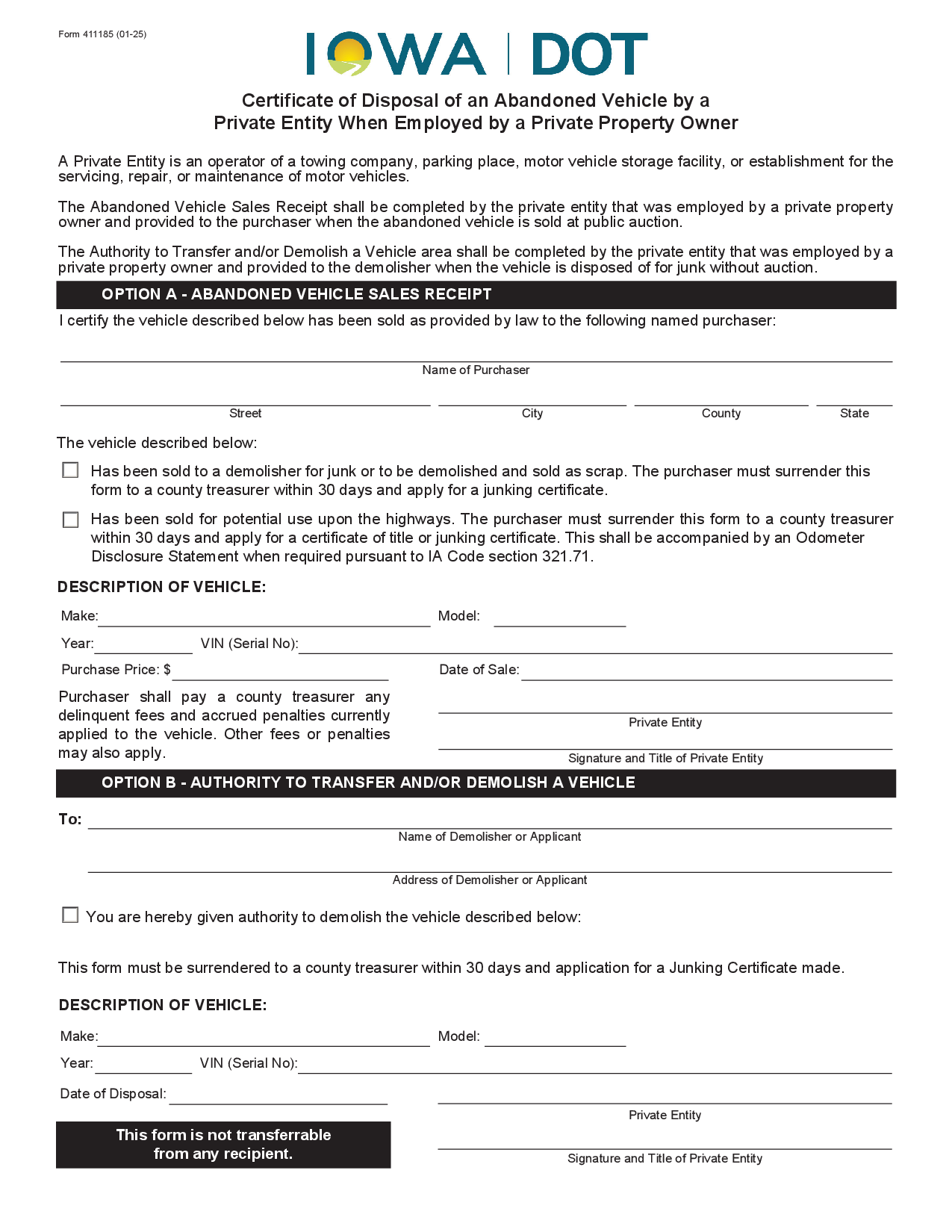
Separate junk authority and brands from road title; obtain the actual sales receipt and applicable odometer disclosure (§ 321.89; 761—480.4). 24
-
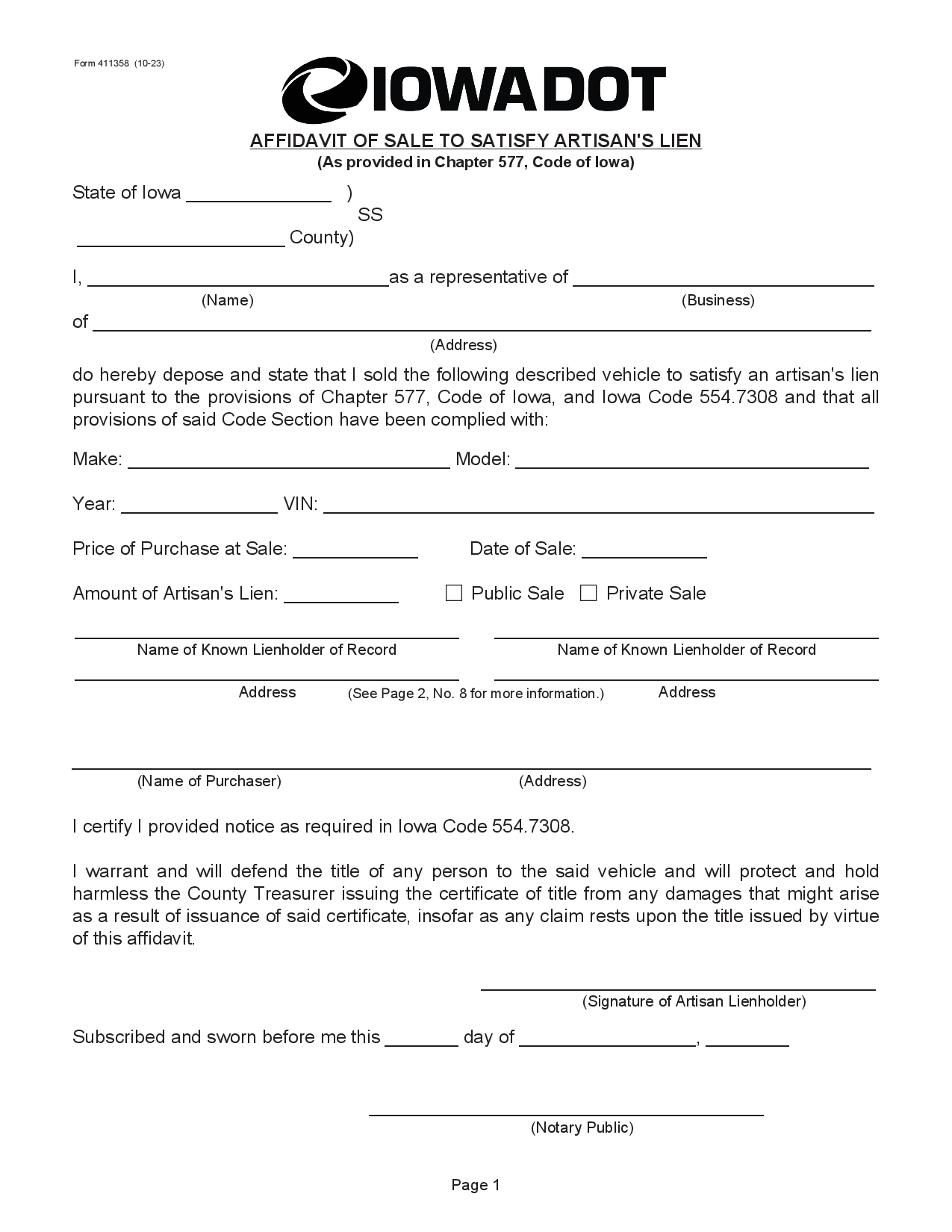
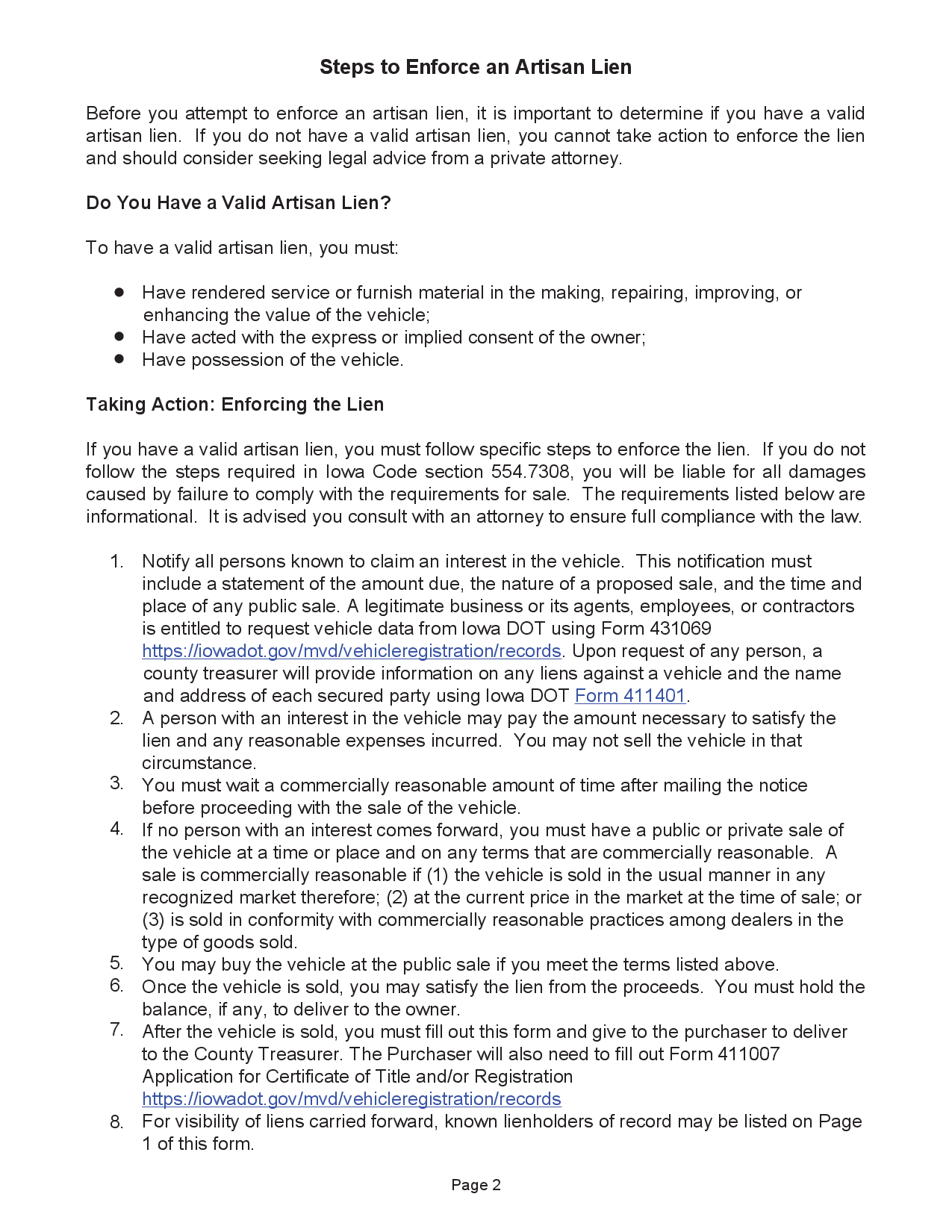
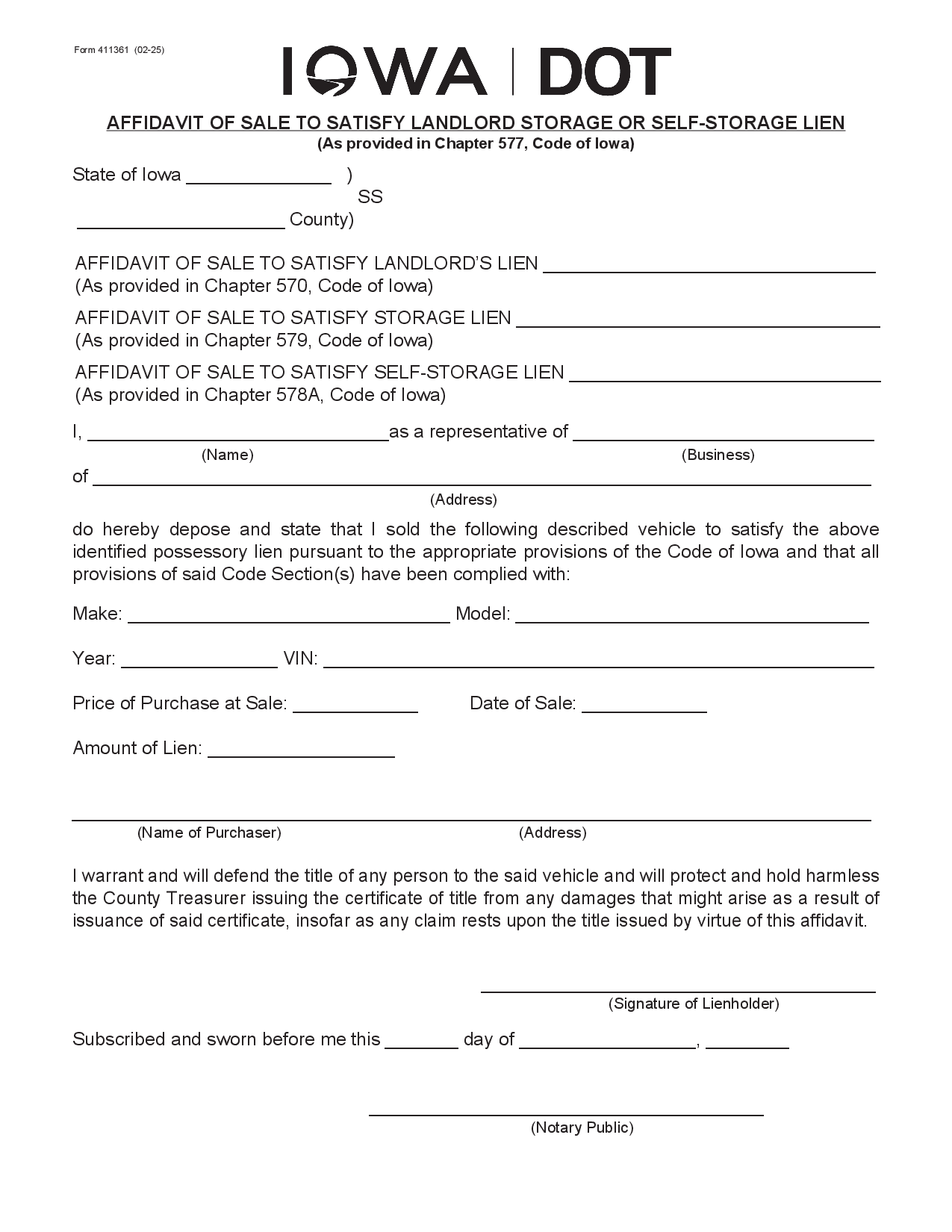
Use actual 411007, 411358 or 411361 and the appropriate sworn proof; do not treat 411361’s erroneous chapter-577 parenthesis as substantive authority. 25
-
For a receiver or assignee obtain the actual approval and lien-treatment order; Parks is not automatic authority against every absent interest (§ 680.4; § 681.25). 26
-
For LLC/partnership auctions identify economic-interest versus sole-member rights and pre-foreclosure satisfaction; company assets are not the member’s collateral (§ 489.503; § 486A.504; § 488.703). 27
-
Resolve tax withholding and the actual acquisition tax exemption separately from title; obtain new alcohol/dealer/grain authority rather than assuming a license passes (§ 423.33; § 321.105A; § 123.38). 28
-
Check every relevant agricultural special priority and filing deadline, including the court-ordered livestock care lien (§ 717.4), before assuming an earlier lender is always senior. 29
-
For an unreleased federal tax lien apply the actual federal judicial/nonjudicial discharge rules; do not invent a 120-day IRS redemption right for ordinary personalty (26 U.S.C. § 7425(d) concerns REAL property). 30
Open questions
Section 12 marks no additional asset-specific question as unsettled in the material used above.
Related
iowa, businesses-and-going-concerns, polk-ia
Primary sources
Legal information, not legal advice. Verify against the cited primary sources before acting. Last verified: 2026-10-17.
Footnotes
-
code422; code96; code10A; code626; code423; code437A; code437B ↩ ↩2 ↩3 ↩4 ↩5 ↩6 ↩7 ↩8 ↩9 ↩10 ↩11
-
code680; code626; receivercase ↩ ↩2 ↩3 ↩4 ↩5 ↩6 ↩7 ↩8 ↩9 ↩10
-
code423; code421; code96 ↩ ↩2 ↩3 ↩4 ↩5 ↩6 ↩7 ↩8 ↩9 ↩10 ↩11 ↩12
-
code423; code423D; ruletax285; revenueguide; actHF960; actHF2757; actSF2465; amended2026 ↩ ↩2 ↩3 ↩4 ↩5 ↩6 ↩7 ↩8
-
code321; code462A; boatfees; code328; code321G; code321I ↩ ↩2 ↩3 ↩4 ↩5 ↩6 ↩7 ↩8 ↩9 ↩10 ↩11 ↩12 ↩13 ↩14 ↩15 ↩16
-
code626; code422; code96; code10A; code423; code437A; code437B ↩
-
code321; rule480; dotabandoned; dotprivatedisposal; dotprivatedisposalpage1; dottitle; actHF2617; amended2026 ↩
-
code321; actHF2617; amended2026; rule480; dotartisan; dotartpage1; dotartpage2; dotstorage361; storage361page1; dot2025feb ↩
-
code322; code203; code203C; actSF2465; current49zip; current46zip; code554; code715D; code423; code421; code96 ↩
-
current26zip; code626; courtcurrentcivil; code614; actSF512; actHF2532; amended2026 ↩