Towing, Storage, Mechanic’s and Self-Storage Lien Sales of Vehicles and Equipment
Asset page (creditor channel). Legal information, not legal advice. Last verified: 2026-10-16.
What it is
A repair shop, tow operator, storage lot or self-storage facility that holds a vehicle or machine may hold a possessory lien under the applicable statute or common law. Whether that lien exists against an owner or lender, whether a sale requires court proceedings, and what a purchaser receives are separate questions. Pennsylvania’s consent/constitutional limits illustrate why possession alone is not universal sale authority; statutory good-faith-buyer protections also distinguish purchaser title from a lienor’s noncompliance liability. See pennsylvania and the channel-specific rules below. This is part of the creditor channel described at court-ordered-administrative-and-creditor-sales; vessel equivalents are at marina-and-storage-lien-sales-of-vessels.
1. Priority: why the lienor usually comes first
- Over the lender. “A possessory lien on goods has priority over a security interest in the goods unless the lien is created by a statute that expressly provides otherwise,” where a possessory lien secures payment “for services or materials furnished with respect to goods by a person in the ordinary course of the person’s business” and “depends on the person’s possession of the goods.” — UCC § 9-333 (https://www.law.cornell.edu/ucc/9/9-333 , retrieved 2026-10-16).
- Colorado reverses that uniform default. Its enacted § 4-9-333(b) grants possessory priority if the creating statute expressly provides it, not automatically unless excluded. For titled vehicles, the earlier continuously possessory repair/storage protection in § 42-6-131 differs from later repairs; first-security-bank-of-idaho-v-crouse-1967 rejects the implied-consent shortcut. Separate public/private/owner-directed tow, article 20 judicial and article 21 retained-property channels; rank is not buyer discharge.
- Over the federal tax lien. A filed federal tax lien is not valid against the holder of a lien “securing the reasonable price of the repair or improvement” of tangible personal property if the holder “is, and has been, continuously in possession of such property from the time such lien arose.” — 26 U.S.C. § 6323(b)(5) (https://www.law.cornell.edu/uscode/text/26/6323 , retrieved 2026-10-16).
- Statutes that limit the lienor. New York’s garage lien is void “as against all security interests … executed prior to the accrual of such lien” if the lienor, more than 30 days after the lien accrues, lets the vehicle out of its possession. — N.Y. Lien Law § 184(1) (https://www.nysenate.gov/legislation/laws/LIE/184 , retrieved 2026-10-16). Texas makes a title lienholder’s lien “superior to the possessory lienholder’s lien” if a repairer omits required notice items. — Tex. Prop. Code § 70.006(b-2). California caps what may be charged to the legal owner without its prior written consent (Cal. Civ. Code § 3068(c)).
Federal limits on a state-law sale. The SCRA, 50 U.S.C. § 3958, requires a prior court order for covered lien enforcement during military service and 90 days afterward. Separately, 26 U.S.C. § 7425(b)–(c) can preserve a filed federal tax lien at a nonjudicial statutory-lien sale without the required federal notice. The ordinary notice rule is at least 25 days; consent and perishable-property exceptions have separate conditions. Both complete sections retrieved 2026-10-17. State priority or clear-title language alone does not establish federal discharge.
2. Texas
Liens. A worker who “by labor repairs an article, including a vehicle, motorboat, vessel, or outboard motor, may retain possession” until paid (Tex. Prop. Code § 70.001(a)); a “garageman with whom a motor vehicle … is left for care has a lien … for the amount of the charges for the care, including reasonable charges for towing … and excluding charges for repairs” (§ 70.003(c)) (https://tcss.legis.texas.gov/resources/PR/htm/PR.70.htm , retrieved 2026-10-16).
Titled vehicles (§ 70.006). The lienholder gives written notice by certified mail to the owner “and each holder of a lien recorded on the certificate of title,” and a repair lienor (other than a franchised dealer) files a copy with the county tax assessor-collector with a USD 25 fee, within 30 days after charges accrue (later deadlines apply to vehicles of 16,000 lb GVWR or more). The non-franchised worker’s additional notice to lienholders must include the repair address, legal name, taxpayer number, “a signed copy of the work order authorizing the repairs,” and the proposed sale date if applicable. These additional worker-notice rules are not universal requirements for every titled-vessel or chapter-70 lien. The owner or lienholder may pay and take the vehicle “before the 31st day after” the filing; if not paid, “the lienholder may sell the motor vehicle … at a public sale” no earlier than the 31st day, and “shall pay excess proceeds to the person entitled to them.” Low-value vehicles may instead go to a demolisher under Transp. Code ch. 683, subch. D. The § 70.006(g) inspection duty belongs to the applicable non-franchised-worker motor-vehicle route, not every chapter-70 boat/garage lien. — § 70.006(a)-(h). Unclaimed excess goes to the county treasurer and, after two years, the county’s general fund. — § 70.007.
Actual packet follow-up, 2026-10-17. The August 2026 Title Manual, chapter 23, distinguishes repair-only VTR-265-M from the storage-fee branch requiring the separate Form VTR-265-S, second notice and recorded-lien release. A release is not required by the current repair-only checklist. VTR-265-FM’s mailing/publication clock differs from the statutory filing language; do not silently give every franchised dealer the independent worker’s county-filing rule. VTR-265-VSF and -SSF are different storage channels. PWD 309A/B/C are also branch-specific: 309C is a licensed vehicle-storage-facility boat/outboard packet, not generic marina paperwork. See texas for current forms, law-enforcement reporting exceptions, exact branch clocks and remaining purchaser-interest questions.
Untitled articles (§ 70.005). For property other than a vehicle titled under Transp. Code ch. 501 or cotton, a lienor in possession for 60 days must request payment if the owner lives in Texas and is known; if not paid “before the 11th day,” the lienholder “may, after 20 days’ notice, sell the property at a public sale”; if the owner is out of state or unknown, the sale may follow day 60 without that notice. — § 70.005(a)-(b). This is a shared procedure for separate lien instances (equipment repairer, stable keeper, pasturer, garment worker, plastic fabricator), not an independent lien and not the titled-vessel process: titled motorboats, vessels and outboard motors follow § 70.006 and the TPWD PWD 309A packet. Section 70.005 does not state the buyer’s title. Feedlot animals use the Article 9 route in § 70.005(c). See texas 12.3.
Vehicle storage facilities. After notice under Occ. Code §§ 2303.151-2303.154, an operator may dispose of an unclaimed vehicle and “may sell the vehicle at a public sale without obtaining a release or discharge of any lien on the vehicle, regardless of whether notice was provided by mail or by publication.” — Tex. Occ. Code § 2303.157(b) (https://tcss.legis.texas.gov/resources/OC/htm/OC.2303.htm , retrieved 2026-10-16). The second notice must state that failure to claim before the 30th day is “a waiver … of all right, title, or interest in the vehicle” and consent to sale. — § 2303.154(b). The facility reports covered intake to local police within two hours, except law-enforcement-requested incident-management tows unless the agency asks for those reports (§ 2303.1511(c)). The owner’s justice-court hearing request is ordinarily due before day 14, excluding weekends and legal holidays, and missing required notice information changes that deadline (§§ 2308.452, 2308.456). TxDMV’s VTR-265-VSF instructions put the earliest sale at the 31st day after the second notice or the law-enforcement notification, whichever is later. See texas 12.3.
Self-storage. When a self-storage lessor enforces its lien on a titled vehicle, it gives additional notice “not later than the 30th day after the date the lessor takes possession” to the owner and “each holder of a lien recorded on the registration or certificate of title,” by verified mail, stating that if not paid “before the 31st day” the property “may be sold at public auction.” — Tex. Prop. Code § 59.0445(a)-(c) (https://tcss.legis.texas.gov/resources/PR/htm/PR.59.htm , retrieved 2026-10-16).
Title. On foreclosure of “a constitutional or statutory lien,” TxDMV may title the purchaser on “the affidavit of the lienholder of the fact of the creation of the lien and of the divestiture of title according to law” and “proof of notice as required by Sections 70.004 and 70.006, Property Code, or by Section 59.0445.” — Tex. Transp. Code § 501.074(c) (https://tcss.legis.texas.gov/resources/TN/htm/TN.501.htm , retrieved 2026-10-16). Storage facilities use TxDMV form VTR-265-VSF (charges, notice dates, sale, purchaser, odometer) (https://www.txdmv.gov/sites/default/files/form_files/VTR-265-VSF.pdf , retrieved 2026-10-16).
Tax note. The 80-percent standard-presumptive-value rule for Texas motor-vehicle tax “does not apply to a motor vehicle disposed of in accordance with Chapter 2303, Occupations Code, or Chapter 70, Property Code.” — Tex. Tax Code § 152.0412(h).
3. Florida
Repair liens (§ 713.585). Persons performing labor or services have a lien on the personal property worked on (Fla. Stat. § 713.58(1)). To sell a vehicle, the lienor sends certified-mail notice to the registered owner, the customer and “all other persons claiming an interest therein or lien thereon” disclosed by Florida or NMVTIS records, within 7 business days after storage charges begin and in no event “less than 30 days before the sale”; a vehicle “may not be sold earlier than 60 days after completion of the repair work.” The notice must disclose the right to a court hearing before sale, the owner’s right to recover the vehicle by bond under § 559.917, that surplus will be deposited with the clerk, and the lienor’s duty to allow inspection within 3 business days of a written request. — Fla. Stat. § 713.585(1) (https://www.leg.state.fl.us/statutes/index.cfm?App_mode=Display_Statute&URL=0700-0799/0713/Sections/0713.585.html , retrieved 2026-10-16). Title transfer requires a clerk-certified certificate of compliance and report of sale, copies of the lien and sale notices, and proof of the NMVTIS check; the department “may not approve” a transfer without the notices. — § 713.585(9). The owner may redeem before sale (§ 713.585(10)), and “a purchaser for value takes title to the vehicle free and clear of all claims, liens, and encumbrances whatsoever, unless otherwise provided by court order” (§ 713.585(12)).
Towing and storage liens (§ 713.78). A towing-storage operator gives certified-mail notice, sent through a DHSMV-approved third-party service within 5 business days after storage, to the registered owner, the insurer and all lienholders shown in Florida or NMVTIS records (§ 713.78(4)(a)); the sale is posted on the approved service’s public website at least 20 days before sale (§ 713.78(6), as amended by ch. 2024-27; see florida 12.3.1). An unclaimed vehicle “may be sold … 35 days after the vehicle or vessel is stored by the lienor if the vehicle or vessel is an older model or 57 days after … if … a newer model”; “newer model” means 3 model years old or less. The sale “must be at public sale for cash.” The certificate of title issued “must be discharged of all liens unless otherwise provided by court order,” and the owner or lienholder may sue after the sale for damages. — Fla. Stat. § 713.78 (https://www.leg.state.fl.us/statutes/index.cfm?App_mode=Display_Statute&URL=0700-0799/0713/Sections/0713.78.html , retrieved 2026-10-16).
Self-storage. If rent on a stored motor vehicle or watercraft is unpaid “for 60 days,” the facility “may sell the property pursuant to this section or have the property towed”; a towing company that takes it “must comply with all notification and sale requirements provided in s. 713.78.” — Fla. Stat. § 83.806(10) (https://www.leg.state.fl.us/statutes/index.cfm?App_mode=Display_Statute&URL=0000-0099/0083/Sections/0083.806.html , retrieved 2026-10-16).
4. California
Liens. A possessory lien exists for repairs, labor, supplies, storage, safekeeping and parking-space rental for a registrable vehicle (Cal. Civ. Code § 3068(a)), and for towing, storage and recovery of vehicles removed by a public agency or under Veh. Code § 22658 (§ 3068.1). A repair lien arising with the registered owner’s consent “shall be extinguished and no lien sale shall be conducted” unless the lienholder applies for lien-sale authorization or sues within 30 days after the lien arises. — § 3068(b)(1).
Sale tracks by value.
| Value | Procedure | Redemption after sale | Buyer’s DMV document |
|---|---|---|---|
| Over USD 4,000 (and self-storage vehicles) | Apply to DMV for authorization; DMV mails notice; owners have 10 days to return a Declaration of Opposition, which forces the lienholder to court; then newspaper notice 5-20 days before sale and certified notice 20 days before. Vehicle available for inspection at least one hour before sale; “Sealed bids shall not be accepted”; sale “in a commercially reasonable manner.” — Civ. Code § 3071(a)-(j) | Yes — “Within 10 days after the sale … the legal or registered owner may redeem the vehicle upon the payment of the amount of the sale, all costs and expenses of the sale, together with interest … at the rate of 12 percent per annum.” — § 3071(k) | REG 168 after the redemption period (DMV Manual) |
| USD 4,000 or less | Lienholder requests owner records; mails Notice of Pending Lien Sale and blank Declaration of Opposition; sale set 31-41 days after mailing. — § 3072(a)-(c) | No — “There is no redemption period. The buyer may take immediate possession.” (DMV Manual) | REG 168A |
Either sale “shall be void if the lienholder does not comply with this chapter.” — §§ 3071(l), 3072(j) (https://leginfo.legislature.ca.gov/faces/codes_displaySection.xhtml?lawCode=CIV§ionNum=3071 , retrieved 2026-10-16). Proceeds pay the lien and a capped processing cost (USD 70 for vehicles of USD 4,000 or less; USD 100 above), and the balance goes to the DMV, where claimants have three years to file. — § 3073. Garage keepers holding a vehicle removed under the Vehicle Code have a lien for towage and safekeeping limited to 60 days (120 days if a lien-sale application is filed within 30 days of removal), and “[n]o lien shall attach to any personal property in or on the vehicle.” — Veh. Code § 22851(a)-(b). The removing public agency classifies the vehicle as worth USD 500 or less, over USD 500 to USD 4,000, or over USD 4,000 for lien-sale purposes. — Veh. Code § 22670(a).
DMV verification steps for the over-USD 4,000 track include confirming that “[t]he 10-day redemption period has passed,” that there is a postal receipt for every party on the DMV authorization, and that postmarks are “at least 20 days prior to the sale date.” — CA DMV Manual, Lien Sales chapter (https://www.dmv.ca.gov/portal/handbook/vehicle-industry-registration-procedures-manual-2/lien-sales-abandoned-abated-vehicles/vehicles-valued-over-4000-or-from-a-self-storage-facility/ , retrieved 2026-10-16).
Self-storage. Rental agreements must warn that property “may even be sold to satisfy the lien
if the rent or other charges due remain unpaid for 14 consecutive days” (Bus. & Prof. Code
§ 21712(a)); a valid declaration in opposition forces the owner to court before sale (§ 21710).
Self-storage vehicles use the REG 168 track (DMV Manual). A registrable vehicle or vessel is a
mandatory exception to the ordinary contents sale: a lien already shown on its title documents has
priority over the self-storage lien, and enforcement must use Civ. Code § 3071 (vehicle) or
Harb. & Nav. Code § 503 (vessel) rather than Bus. & Prof. Code §§ 21705-21711, so the ordinary
contents good-faith purchaser rule is not the vehicle rule; after 60 days unpaid the facility may
instead arrange the specified tow on at least 10 days’ notice. — Bus. & Prof. Code § 21702.5(a)-(e)
(https://leginfo.legislature.ca.gov/faces/codes_displaySection.xhtml?lawCode=BPC§ionNum=21702.5).
Whether the senior title lien survives the sale is needs_verification; see california 12.3.
5. New York, Illinois, Ohio (short form)
- New York. Garage, storage and repair lien on motor vehicles, motor boats and aircraft, “whether or not such motor vehicle … is subject to a security interest” (Lien Law § 184(1)); a possessory lien on personal property may be satisfied by sale under Lien Law article 9 (§ 200) (https://www.nysenate.gov/legislation/laws/LIE/200 , retrieved 2026-10-16); surplus is held for the owner and persons entitled to notice, and if unclaimed within 30 days is deposited with the local treasurer or chamberlain (§ 204). Verified notice (§ 201), the 10-day contest proceeding (§ 201-a), advertised public auction (§ 202) and pre-sale redemption (§ 203) are summarized in the New York follow-up below and in new-york 12.3.
- Illinois. A non-possessory chattel lien for labor, skill, materials or storage lasts one year (770 ILCS 45/1) if a lien notice is recorded within 60 days of delivery (770 ILCS 45/2). Self-storage: a vehicle, trailer or watercraft unpaid for 60 days may be towed; if the operator instead sells a titled item it must check Secretary of State records and “notify every identified title holder or lienholder of the time and place of the proposed sale.” — 770 ILCS 95/4(G-5) (https://www.ilga.gov/Documents/legislation/ilcs/documents/077000950K4.htm , retrieved 2026-10-16). Under the Labor and Storage Lien (Small Amount) Act, a complying disposition needs no suit: the property must be unredeemed 90 days after the services or storage were completed (or after the agreed redemption date), with at least 30 days’ certified-mail sale notice and one newspaper publication at least 30 days before a commercially reasonable public or private sale; an otherwise surviving security interest continues (810 ILCS 5/9-315) unless its holder authorizes the disposition. — 770 ILCS 50/2, 50/3, 50/5 (https://ftp.ilga.gov/ILCS/Ch%200770/Act%200050/077000500K2.html , as cited in illinois 12.3).
- Ohio. A repair garage or storage place holding a vehicle worth less than USD 3,500 unclaimed 15 days after completion must search title records and send certified notice to owners and lienholders; if unclaimed 15 days after notice it may obtain a title by affidavit, and “[u]nless the lienholder claims the motor vehicle within fifteen days from the sending of the notice, the lienholder’s lien is invalid.” — Ohio R.C. § 4505.101(A) (https://codes.ohio.gov/ohio-revised-code/section-4505.101 , retrieved 2026-10-16). Towing services and storage facilities have a separate qualifying route for towed vehicles under USD 3,500, with sixty days after notice receipt or undeliverability, not the garage’s sending-based fifteen days. — §4505.101(B). Self-storage notices go to “[a]ll persons holding liens on any motor vehicle or watercraft amongst the property,” and a lienholder may pay the lien and expenses and enter a new rental agreement. Separately, §5322.03(H)(1) permits immediate removal of a vehicle or watercraft on proof of a lien/ security interest or qualifying court order without paying the operator’s lien or expenses. That right must not be replaced by a payment requirement. Actual good-faith auction protection under(I)(2)and consent under5322.02(A)(2) require their own analysis; neither universal lender survival nor universal discharge follows from this short summary. — R.C. §5322.03(A)(2),(H),(I) (https://codes.ohio.gov/ohio-revised-code/section-5322.03 , retrieved 2026-10-16).
Arkansas repair amendment — 2023 enacted procedure
Act388 changes the general mechanic/artisan sale procedure: thirty days from certified demand, not work completion; ten-day business-door posting plus certified sale notice; circuit-clerk filing and a fair-market-value bond. The extra five-posting requirement and older court-set bond procedure were deleted. Registered motor vehicles still use the separate §27-50-1101 rule. This is not a universal aircraft/rent/title-discharge shortcut; see arkansas.
New York follow-up — 2026-10-17
Full official Lien 201, 201-a, 202, 203 and 204 were retrieved. Section 201 requires verified, itemized notice and diligent personal service before applicable fallback certified return-receipt and first-class mail. Publication under § 202 follows the actual payment deadline, not simply lien creation: two weekly insertions and sale fifteen days after the first, subject to the exact low-value alternatives. Section 203 allows pre-sale redemption; § 204’s thirty-day local deposit and five-year escheat govern surplus, not a universal purchaser-title warranty. These later retrievals supersede the older unretrievable-source limit, not its historical accuracy.
The cases distinguish valid lien/invalid sale, retained towing charges and service-defect conversion. They do not decide every downstream buyer’s title. See new-york for actual case pages, separate state/federal vessel paths, current forms and unresolved title questions.
Louisiana follow-up — 2026-10-17
R.S. 9:4501’s repair privilege and sequestration must be distinguished from § 4502’s additional private-sale route and subsection (D)‘s exclusions. Do not import the latter’s ten-day pre-sequestration notice into § 4501 or infer every repairer may privately sell. Section 32:1720 distinguishes five business days for electronic record information from ten for mailed information; § 1728’s final notice has separate storage-date, consent and vehicle-age conditions. Policy 20.00, July 8, 2026 identifies ORSV and DPSMV 1821/1822/1820/1976; permit issuance is not a ruling that all lender interests are extinguished. jefferson-financial-v-billys-used-cars-la-m12-2010 is a joinder remand, not a lender-priority merits determination; gilpin-v-murphy-la-m12-2024 is unpublished and concerns its historical permit/contract record, not a validated completed resale. See louisiana for current nonconsensual-tow rate scope and still-open title/cap questions.
Connecticut — October 2026 towing is a distinct route
P.A. 26-24 § 37 amends § 14-150c from October 1, 2026: thirty days before intent to sell, fifteen-model-year auction branches, regular sale-notice mail distinct from dual initial-tow mail, the five-business-day proposed-sale-notice period and younger-vehicle advertising must not be replaced by obsolete dollar branches. The DMV sale procedure separates pre/post-October forms. The actual new H100 prints 11-2026 despite October 17 retrieval; H114 prints 10-2026. Do not invent a November issuance date or treat the older H100 1-2026 as the newest form. The public DMV portal mandate starts January 1, 2027, not October 2026. dutch-point-credit-union-v-caron-auto-works-1994 and stone-v-east-coast-swappers-2020 have limited holdings; a private repairer decision is not universal police-tow constitutional notice law. See connecticut.
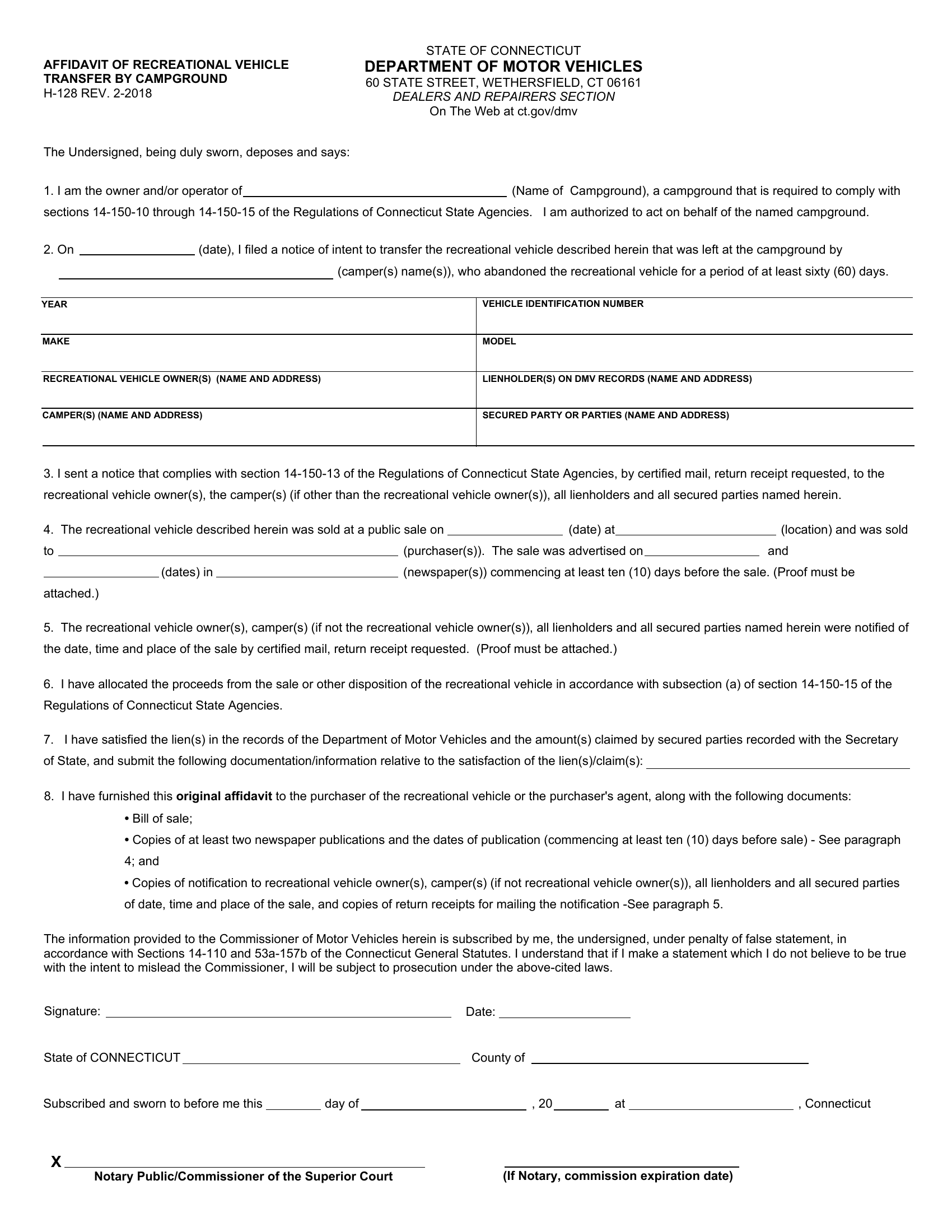
Connecticut campground sales are another packet. The complete DMV-authored H128, rev. 2-2018, mirrored blank attests satisfaction of both DMV title liens and amounts claimed by SOTS secured parties. Read it with RCSA 14-150-10–15. Historical form identity is established; present agency acceptance and an unpaid lender’s discharge remain separate, unresolved questions.
For Connecticut service/material liens, § 42a-9-109(d)(2) excludes the statutory lien from Article 9 except its § 9-333 priority rule. Priority therefore does not itself import Article 9 purchaser protection or statutory damages into §§ 49-60/70/75/76. Entrustment under § 2-403 can independently transfer the entrusting owner’s rights, not automatically an independent lender’s rights. richmond-v-f40-restoration-2020 concerns replevin against a downstream car possessor, not a universal lien-sale rule.
Delaware — four tow/custody mechanisms are not interchangeable
Chapter 69A’s private-parking route has its own thirty-day notice/sixty-day delivery predicates and USD 250/50 caps. Chapter 69 includes the police judicial-sale and § 6902 DMV salvage-hearing routes; neither is simply Title 25, chapter 39’s seven-business-day priority procedure. A cap or clear-title conclusion from one channel cannot be exported to the others. See delaware for actual current forms and the separately unresolved buyer-interest questions.
Pennsylvania — lien validity before sale power
associates-financial-v-odell-pa-1980’s historical nonassenting-finance-holder result is not a universal present repair-lien veto. williamsport-national-bank-v-shrey-pa-1992 recognizes qualifying possessory repair priority without the lender’s repair consent; current § 9333 retains its statutory qualifications. The later Iguestas application is Common Pleas authority, not a Supreme Court ruling. Owner authorization/lien creation, lender priority, sale legality and purchaser discharge are separate gates. Section 9333 ranks a qualifying lien; it does not itself create one. The actual general 1925 Act 300 and 1864 Act 965 are available, not nonexistent. Their present summary-sale/hearing effect requires the specific constitutional and later-treatment analysis recorded in pennsylvania; no universal private-auction clean title follows. Salvor, marine-business, trailer-dealer and self-storage protections are different routes, not exceptions to erase from a generic repair rule.
Article 9 § 9109(d)(2) excludes the described services/materials liens apart from § 9333 priority; § 9617’s secured-party-sale discharge is not automatically an artisan-auction rule. bernstein-v-hineman-pa-1925 and welded-tube-v-phoenix-steel-pa-1975 supply actual conversion/waiver consequences, not every later buyer’s rights. wilson-v-malenock-pa-1937 upholds waiver where the repairer looked solely to another payer; mere insurer involvement does not establish that finding. The full 1953 Act 1, §§ 9-104(c), 10-102 confirms selective inconsistency repeal, not wholesale abolition of repair liens or present constitutional clearance of every 1925-act sale. See pennsylvania for actual later Parks/Flagg treatment and remaining questions.
Indiana — requested service is not every abandoned-property tow
Separate owner-requested IC 9-22-6-2 from private-property abandonment and nonpossessory recorded-lien routes. The official 2026 statute has 30 days before advertising and 15 days after the later publication/mail event (a 45-day minimum), with public auction mandatory over USD 3,500 for abandoned-vehicle tows (IC 9-22-1-21.5(c)). Its proof-of-mailing wording must be distinguished from the historical facts in banks-v-jamison-2014; sperro-v-ford-motor-credit-2016 is not a universal authorization to defeat a prior lender by a manufactured tow.
The actual BMV packets use 205, R14/4-26, and 23104, R8/12-24, plus applicable newspaper certification and supporting records. BMV’s valuation/delivery wording and the recovered statute differ; neither is silently substituted for the other. A proceeds formula is not proof that every prior lien is discharged. See indiana 12.3, which now reads the official 2026 Indiana Code title PDFs, for these source/packet discrepancies.
Illinois — the sheriff route is not the only lien-sale route
The Labor and Storage Lien Act45/6 sheriff process differs from qualifying over-USD2,000claims under 90/3 and the small-amount 50/2 sale. Surrendered-possession preservation under 45/2 uses the county recorder, within60days after delivery back; do not replace that office with a generic FAA-manual county-clerk example. 45/4 expressly protects the specified prior recorded lender; a sale does not automatically erase that interest.
For vehicle applications the actual VSD526.19, March2026 lien affirmation and VSD190transaction application require the channel’s sale/notice proof. Impound Certificate of Purchase VSD106.12, March2026 supports its specified salvage/junk route, not universal clean road title;4-215has qualified exceptions. illinois supplies the recovered full4-201–216and current forms. Its 95/4(G-5)storage rule separately requires agency/title-holder/lender checks for the enumerated titled assets, not merely a voluntary SOS form custom.
Wisconsin — adjusted priority limits and a vehicle-value route split
For work commenced on/after January1,2026, the actual mechanic adjustment notice sets the §779.41 lender-priority thresholds at USD 3,050 general, USD 9,140 qualifying trailers and USD 15,200 listed machinery, with separate heavy-vehicle classes. These govern priority against an earlier perfected lender under the statute’s consent rules; they are not a universal cap on the customer’s repair invoice. The boat subsection’s USD 1,200 is separate and unindexed.
The actual 2026towing/storage notice sets the vehicle-value route split at USD 1,090, not USD 750 and not a towing-charge cap. For vehicles subject to the specified title lien, tow priority is USD 150/510 and storage priority USD 14/37 per day, with USD 880/2,190 totals, depending on the 20,000-pound class. The commencement/effective-period conditions matter. The larger-value §779.48(2)route differs from the conditional lower-value sale/junking route. wisconsin supplies every class, notice/clock and purchaser consequence; no federal mortgage purge is inferred.
South Carolina — continuous possession and distinct aircraft enforcement
Section29-15-10 requires continuous possession, the appropriate owner/lienholder searches and notice, and its thirty-day wait before the magistrate auction. The seven-business- day limit concerns storage charges before the location notice, not all later storage charges. welcome-home-center-v-central-chevrolet-1978 holds that voluntary release extinguished the earlier repair lien; later custody did not revive it for old debt after current charges were tendered. Aircraft §29-15-100instead incorporates Common Pleas vessel-lien procedure. See south-carolina for the actual current search, notice, posting and surplus conditions; magistrate sale is not blanket all-lien discharge.
Minnesota — a requested bailee lien is not the police-impound route
Section514.18 requested storage/repair, §168B.045 impound charges and §16B.58 state-parking authority are distinct. Under §514.20, the title-listed creditor gets certified notice 45 days before the sale right becomes effective; noncompliance makes the lien ineffective against that creditor. The ordinary ninety-day nonpayment/public-auction route and the licensed- dealer alternative in §514.21 have different owner-notice/conduct conditions. Possessory priority alone does not confer universal auction-cleansing immunity. The actual compliant §168B.08 impound sale has its own discharge rule. See minnesota for the precise branches.
Minnesota police towing under168B.045excludes snow-emergency parking tows; that exclusion does not erase separate168Bimpound-disposal authority. Minneapolis/St.Paul’s168B.051(1a)initial certified notice starts fifteen days, with timely intent extending to45and no second notice; the ordinary thirty-day second-notice branch elsewhere is different.
For covered nonpublic/exclusively contracted public lots, 168B.07(3d) provides injunction/fees while contents remain and conditional USD 1,000damages/fees after sale following the required documentation. The twelve-month deadline expressly attaches to paragraph(d)‘s damages, not every injunction. Separate self-service storage514.972protects specified papers/health aids and conditionally documented clothing/trade tools; it is not the bailee grant514.18. See minnesota for the exact retrieval, deposit and sale limits.
Kentucky — conditional release is not universal clean title
Section376.275 requires its owner/lender notices and separate waiting conditions; a prior recorded lien ordinarily remains unless the stated conditional release/title route is satisfied. Even that release excludes tax liens. TC96-159T,11/2025 does not enlarge the statutory first-ten-day notice period by calling it business days. Government-requested towing and the 502KAR15:020 state-highway procedure are separate; the latter supplies an excess-to- State-Police accounting after the stated liens, not a rule for every private tow. Independent surplus obligations are not erased by a known title or priority rule; kentucky distinguishes the actual channels and remedies.
The completed review applies the general accounting rule from Jones and Tidwell to excess after lawful standalone376.275/.280/.455charges, respecting actual ownership/priority. This is an expressly identified synthesis, not an invented special statutory waterfall. Express marina, self-storage, road and State Police residue rules remain separate. A transaction’s competing claims do not turn that supplied conditional rule into unfinished legal research.
Nevada — whole-lien priority is not an excess-only allowance
Section108.290 ranks the whole motor-vehicle towing/storage/related-fee lien: during its first thirty days, no more than USD 1,000 is first and a larger lien second; afterward the dividing amount is USD 2,500. This differs from the vessel provision’s excess-only rule. Expiry has certified-tower/tolling exceptions; landlord limits are not a universal towing cap.
Chapter706’s twenty-one-day notice branch concerns the specified police-requested crash tow, not every tow; the other nonowner branch uses fifteen days. Four-business-day crash/recovered-theft restrictions and chapter487’s fact-specific junk exception remain separate. Itemized repair notice/storage-report duties can also be joined by 487.010(5)‘s separate fifteen-day legal-owner/security-holder notice duty; the crash21-day branch does not silently replace it. These duties can affect validity. Section108.350’s innocent-third-party protection does not excuse the claimant’s own liability, and National Tow does not erase that statutory distinction. See nevada for the complete routes and forms.
Washington — compliant tow ownership termination is a distinct rule
WAC308-61-190(1) terminates prior registered/legal ownership at the compliant chapter46.55 auction. The operator-generated Abandoned Vehicle Report–Affidavit of Sale and TD-420-001support the title application. This is not the chapter60.10repair-sale rule preserving superior liens, nor a decision that every invalid auction protects its buyer.
RCW46.55.118 limits qualifying classA/E/D private impounds to135% of the specified WSP hourly/storage benchmarks and100% of the after-hours-release benchmark. Vehicle condition and statutory exclusions matter; law-enforcement impounds, voluntary towing and other truck classes are not automatically covered. The USD 500/1,000 deficiency rules are not universal towing-charge caps. See washington for the exact notice, accumulation and challenge rules.
Kansas — tow, repair and storage packets are different
A qualifying 8-1103 tow creates its own prior lien and conditional thirty-day sale route; known-owner notice, actual notice/publication and the purchaser’s compliance certificate remain required. Storage-fee notice and private-property ordinance conditions matter. The TR-85 tower packet is not the TR-105 public-agency packet. The latter’s residue rule cannot simply be imported into a private tow. Repealed8-1106is not a current county-treasurer surplus rule. kansas explains the general security/accounting synthesis from Denny and Cooper, not a fictional statewide special statutory waterfall. The actual Overland Park police-tow ordinance has local known/unknown-claimant, clerk-ten-day and seven-day report duties; do not generalize that local distribution statewide.
58-201/202 repair and 58-208 bailee storage are separate from that tow. The current TR-96S packet asks for certified/ restricted-mail and newspaper proof even though 58-817 permits other stated notice/advertising methods. Do not call every statutory minimum an agency-approved alternative packet. 58-817a termination/nonrenewal disposal has separate45-day/15-day conditions and residue rules, not a newly created lien. One displayed title lien is not proof that all support, repair, tax or federal interests are absent.
Missouri — repair completion and storage accrual start different clocks
430.082 requires the qualifying written request/charges. Repair completion/default and storage accrual have distinct45-day predicates; the actual 1062/5835 lien-title packet includes thirty-day certified owner/lender notice. After lien title, proceedings under430.100must begin within ten days. Do not impose 430.090’s three-month petty-repair wait universally. The distinct 304.155 abandoned-tow grant has its own authorization and disposal restrictions; scrap-only recipients are not ordinary road-title buyers. missouri retains conditional lien survival and the express430.082aircraft grant, distinct from an unpromised agency acceptance of a particular vehicle-style title packet.
6. Buyer’s checklist specific to lien sales
- Identify the statute (repair, tow, storage, self-storage) and the value track.
- Obtain copies of every notice and its mailing proof; confirm notices went to every lienholder on the current title and any out-of-state title (Florida and Ohio require title or NMVTIS searches).
- Confirm statutory waiting periods ran (Texas: 31 days after county filing for an independent repairer, with different franchised-dealer, storage-branch, VSF and self-storage clocks — see texas 12.3; Florida 60 days after repairs / 35 or 57 days after towing; California 31-41 days or DMV authorization).
- Confirm no Declaration of Opposition or court hearing demand is pending (California § 3071(c); Florida § 713.585(1)(l)).
- In California over-USD 4,000 sales, price in the 10-day redemption tail (§ 3071(k)).
- Personal property inside the vehicle is not part of the lien in California (Veh. Code § 22851(b)).
▸ For Buyers / Operators. Florida repair and tow sales and Texas storage-facility sales give lien-free title by statute when the lienor complied; California sales are “void” on non-compliance and, over USD 4,000, can be redeemed for 10 days. A defective notice can leave a title lender’s lien in place (Tex. Prop. Code § 70.006(b-2)). The document package from the lienor is the asset.
▸ For Owners / Debtors. Pre-sale redemption by paying the lien (Fla. § 713.585(10); Tex. § 70.006(e)), the right to inspect repairs (Tex. § 70.006(g); Fla. § 713.585(1)(p)), hearing and bond rights (Fla. § 713.585(1)(l)-(m)), the Declaration of Opposition (Cal. §§ 3071-3072), the 10-day post-sale redemption in California, and surplus held by the clerk, county treasurer or DMV are the operative protections.
How jurisdictions diverge
| Pattern | Jurisdictions | Notes |
|---|---|---|
| Statutory free-and-clear title to lien-sale buyer | florida | §§ 713.585(12), 713.78 |
| Sale without lien release by licensed storage facility | texas | Occ. Code § 2303.157(b) |
| Post-sale owner redemption (10 days, 12%) | california | Civ. Code § 3071(k), vehicles over USD 4,000 |
| Garage obtains title directly (not by sale) for low-value vehicles; non-claiming lienholder’s lien invalid | ohio | R.C. § 4505.101 |
| Garage lien void against prior security interests if possession released after 30 days | new-york | Lien Law § 184 |
| Self-storage vehicles may be towed into tow-lien procedure after 60 days | florida, illinois | Fla. § 83.806(10); 770 ILCS 95/4(G-5) |
Leading cases
- flagg-bros-v-brooks-1978 — a private warehouseman’s statutory lien sale is not state action, so the Fourteenth Amendment does not itself require a hearing before a private possessory-lien sale.
Cross-links
court-ordered-administrative-and-creditor-sales, motor-vehicles, equipment-and-machinery, ucc-article-9-dispositions, forfeiture-and-government-seizure-sales, buying-a-vehicle-at-a-forced-sale, marina-and-storage-lien-sales-of-vessels, texas, florida, california, new-york, illinois, ohio
needs_verification
- New York: downstream buyer’s title after a Lien Law article 9 sale (§§ 201–204 now retrieved; see new-york 12.3).
- Tex. Occ. Code §§ 2303.151-2303.153 notice timing and contents are now set out in texas
12.3; the VSF fee adjustment after the 2023 TDLR adjustment remains
needs_verificationthere. - Florida § 713.78 notice timing (DHSMV-approved third-party service within 5 business days; website posting at least 20 days before sale), rate-structure caps and the § 559.917 / § 713.78 bond routes are now set out in florida 12.3.
- California self-storage notice and sale steps (Bus. & Prof. Code §§ 21703, 21705, 21707) are now in california 12.3; senior title-lien survival after a vehicle/vessel sale remains open there.
Iowa — ordinary storage and abandoned vehicles differ
Chapter579 storage liens on vehicles/boats remain subject to all prior record liens. Its public auction, ten-day owner notice if found in county, three township postings and owner-surplus rules are not the abandoned-vehicle process. Chapter577 artisan priority has its own prior-lien written-consent and special avionics conditions; iowa-truck-center-v-davis-1973 reversed a pleading dismissal, not a final finding that every asserted artisan debt/lien was valid.
For qualifying abandoned registered vehicles, §321.89 as amended by2026HF2617 uses TEN-day certified dispatch and TWENTY-day reclaim, not the reversed older clocks still appearing in some guidance. Good-faith purchaser protection and title processing arise under the actual 761—480 route, not merely a garage’s possession. The current two-media/seven-day auction advertising provision coexists with a newspaper-page retention requirement; newspaper plus another proper medium and that page satisfy both. This is a bounded compliance answer, not certification of a newspaper-free record set. Actual private411185 does not substitute for police-only411163, whose current full body/revision remains source-limited. See iowa for the full current notice, contents, fees and title packet.
Mississippi — separate tow, repair, abandonment and insurer routes
Current 2026 SB 2848 preserves distinct § 85-7-251 towing and chapter 63-23 abandonment channels: two website weeks for towing versus three for abandonment, not the DOR bulletin’s two-week safe harbor. Repair enforcement under § 85-7-107 requires its special court sale order and five-day certified pre-suit notice. Cole distinguishes possession-based perfection from liquidation and limits secured repair charges to labor/materials, not storage or unadjudicated filing fees.
The historic five-day private-parking tow predicate was deleted by 2020 HB 359, not first in 2026. Insurer-directed salvage assignment under § 83-11-551(9), enacted by 2021 SB 2603, is a separate title route, not another lien grant. See mississippi for actual packets and source boundaries.
New Hampshire — separate grants and actual title packets
RSA450 creates separate storage and repair liens; vehicle and aircraft branches do not multiply the grants. After sixty days unpaid, its public sale incorporates RSA444: two town postings at least fourteen days ahead, owner service if county-resident, and the actual publication/inquiry branches. Above USD100, the unqualified newspaper requirement uses RSA21:32’s three successive weeks, last publication at least one week before sale, absent a governing special schedule. Priority requires the actual service, possession and owner-authorization predicates; a new title does not itself purge a protected lender.
The complete Saf-C1900 rules establish different garage, repossession and abandonment packets. TDMV71 is a removal/report document, not the buyer’s application. Standalone TDMV108/16 and the title handbook returned403; recovered rule text is not a claimed download of those forms. Iacomini addresses authority and priority; Dan’s City rejects federal preemption of the particular post-towing storage/disposal claims, without deciding their ultimate merits. See new-hampshire for actual channel rules.
North Dakota — greater-of priority and distinct title processing
Chapter35-13 uses the greater of USD6,000 or30% of repaired value, or the greater of USD15,000 or30% for agricultural/construction property. To claim full priority above that amount, give the actual registered/certified estimate notice. Failure to notify or a recorded lender’s written objection within five days limits priority to the statutory amount; it does not invalidate the whole lien. Nonjudicial disposition incorporates North Dakota Article9 and the specific ten-day foreclosure notice.
Actual DOT packets are not one universal sheriff form. The registration manual’s thirty-day receipt/undeliverable-return title instruction is distinct from that ten-day sale statute. SFN2872 and repo SFN2880 print4-2026. Chapter23.1-15’s government-auction, tower vesting and scrap branches have their own predicates. See north-dakota for actual lookup, indemnity, assignment, release and disclosure evidence.
Rhode Island — judicial enforcement is not exclusive
Section34-35-6 preserves independently lawful statutory/contractual remedies. Chapter34-35 enforces an existing lien; it does not create a lien for bare automobile storage. Case v. Bogosian supplies that distinction. Certificated towers have a distinct nonjudicial public auction under 39-12.1-9, with the actual ten/sixty-day initial-notice branches, additional sale notice, statutory purchaser protection and receipt/bill/compliance-affidavit packet. Do not extend that route to every garage or storage operator.
Self-storage34-42-4 now permits the prescribed website advertisement or newspaper alternative and an online sale. The five/fourteen-day notices, sixty-day default minimum and fifteen days after final publication remain distinct. Its good-faith purchaser protection, two-year surplus rule and damages/conversion remedies are not the tower statute. See rhode-island for the exact applicable predicates.
New Mexico — sale notice and title packet are different duties
The actual ten-day demand, twenty-day sale notice and vehicle holding conditions are distinct from 18.3.12.26’s ownership request within three business days and identified owner/lender notice within two business days. Failure of the latter notice forfeits storage charges; possessory priority alone does not answer purchaser discharge.
MVD Chapter8(Q) and actual MVD10002,REV05/24 require the applicable certified writ/order, sheriff-signed published notice, sale bill and VIN/odometer/ownership evidence. Existing liens need actual release or a binding order; receiving a new title is not a universal clean-title finding. new-mexico separately states the pre-seizure exemption-notice duty and the unrecovered AOC publication needed for current adjusted exemption amounts.
South Dakota — do not erase the motor-vehicle exclusion
The final sentence of 44-11-1 excludes motor vehicles from that section, not just its ninety-day abandonment paragraph. Do not turn the general lien or chapter21-54’s title language into a universal vehicle-storage lien and lender purge.
The specific 32-3-67–69 route applies to actual unpaid-repair possession, now including the listed boat/trailer and vehicle categories under the 2026 amendment. Obtain the owner/lender lookup, certified owner/insurer/lender notice and department form. The sending, receipt and reclaim/removal thirty-day clocks are distinct. Actual vesting predicates, mandatory public auction and excess payment to entitled parties still govern; unreachable parties’ excess follows the unclaimed-property provision. south-dakota distinguishes these rules from ordinary execution, other liens and Scotlynn’s limited holdings rather than treating a remand as final title approval.
Sources
- {model statute, https://www.law.cornell.edu/ucc/9/9-333, retrieved 2026-10-16} — UCC § 9-333.
- {statute, https://www.law.cornell.edu/uscode/text/26/6323, retrieved 2026-10-16} — 26 U.S.C. § 6323(b)(5).
- {statute, https://tcss.legis.texas.gov/resources/PR/htm/PR.70.htm, retrieved 2026-10-16} — Tex. Prop. Code §§ 70.001, 70.003-70.007.
- {statute, https://tcss.legis.texas.gov/resources/OC/htm/OC.2303.htm, retrieved 2026-10-16} — Tex. Occ. Code §§ 2303.154, 2303.157.
- {statute, https://tcss.legis.texas.gov/resources/PR/htm/PR.59.htm, retrieved 2026-10-16} — Tex. Prop. Code § 59.0445.
- {statute, https://tcss.legis.texas.gov/resources/TN/htm/TN.501.htm, retrieved 2026-10-16} — Tex. Transp. Code § 501.074(c).
- {form, https://www.txdmv.gov/sites/default/files/form_files/VTR-265-VSF.pdf, retrieved 2026-10-16} — TxDMV VTR-265-VSF.
- {statute, https://tcss.legis.texas.gov/resources/TX/htm/TX.152.htm, retrieved 2026-10-16} — Tex. Tax Code § 152.0412(h).
- {statute, https://www.leg.state.fl.us/statutes/index.cfm?App_mode=Display_Statute&URL=0700-0799/0713/Sections/0713.58.html, retrieved 2026-10-16} — Fla. Stat. § 713.58.
- {statute, https://www.leg.state.fl.us/statutes/index.cfm?App_mode=Display_Statute&URL=0700-0799/0713/Sections/0713.585.html, retrieved 2026-10-16} — Fla. Stat. § 713.585.
- {statute, https://www.leg.state.fl.us/statutes/index.cfm?App_mode=Display_Statute&URL=0700-0799/0713/Sections/0713.78.html, retrieved 2026-10-16} — Fla. Stat. § 713.78.
- {statute, https://www.leg.state.fl.us/statutes/index.cfm?App_mode=Display_Statute&URL=0000-0099/0083/Sections/0083.806.html, retrieved 2026-10-16} — Fla. Stat. § 83.806.
- {statute, https://leginfo.legislature.ca.gov/faces/codes_displaySection.xhtml?lawCode=CIV§ionNum=3068, retrieved 2026-10-16} — Cal. Civ. Code §§ 3068, 3068.1, 3071, 3072, 3073 (same URL pattern).
- {statute, https://leginfo.legislature.ca.gov/faces/codes_displaySection.xhtml?lawCode=VEH§ionNum=22851, retrieved 2026-10-16} — Cal. Veh. Code §§ 22851, 22670.
- {statute, https://leginfo.legislature.ca.gov/faces/codes_displaySection.xhtml?lawCode=BPC§ionNum=21712, retrieved 2026-10-16} — Cal. Bus. & Prof. Code §§ 21710, 21712.
- {agency manual, https://www.dmv.ca.gov/portal/handbook/vehicle-industry-registration-procedures-manual-2/lien-sales-abandoned-abated-vehicles/vehicles-valued-at-4000-or-less/, retrieved 2026-10-16} — CA DMV Manual lien-sale pages.
- {statute, https://www.nysenate.gov/legislation/laws/LIE/184, retrieved 2026-10-16} — N.Y. Lien Law §§ 184, 200, 204.
- {statute, https://www.ilga.gov/Documents/legislation/ilcs/documents/077000450K1.htm, retrieved 2026-10-16} — 770 ILCS 45/1-3; 770 ILCS 95/4.
- {statute, https://codes.ohio.gov/ohio-revised-code/section-4505.101, retrieved 2026-10-16} — Ohio R.C. §§ 4505.101, 5322.03.
- {case, https://supreme.justia.com/cases/federal/us/436/149/, retrieved 2026-10-16} — Flagg Bros., Inc. v. Brooks, 436 U.S. 149 (1978).
- {statute, https://tcss.legis.texas.gov/resources/OC/htm/OC.2303.htm, as cited in texas 12.3} — Tex. Occ. Code § 2303.1511(c); hearing rules at https://tcss.legis.texas.gov/resources/OC/htm/OC.2308.htm (§§ 2308.452, 2308.456).
- {statute, https://leginfo.legislature.ca.gov/faces/codes_displaySection.xhtml?lawCode=BPC§ionNum=21702.5, as cited in california 12.3} — Cal. Bus. & Prof. Code § 21702.5.
- {statute, https://ftp.ilga.gov/ILCS/Ch%200770/Act%200050/077000500K2.html, as cited in illinois 12.3} — 770 ILCS 50/2, 50/3, 50/5.
Disclaimer. This page is legal information, not legal advice. It is a general, cross-jurisdiction summary that may be incomplete or out of date; law varies by jurisdiction and changes frequently. Nothing here creates an attorney-client relationship. Verify every deadline and statute against the current primary source and consult a licensed attorney in the relevant jurisdiction before acting.